July 27, 2012

Married by the Mob

By Caitlin Patterson
Data Technician, Montana Digital Newspaper Project


Montana’s newspapers often published brief announcements about town visitors, residents who were injured or taken ill, and guests at private gatherings. Most “personals” were one- or two-sentence snippets, but once in awhile an event was entertaining enough to qualify for more detailed treatment.

This was the case in a November 1865 issue of the Montana Post, recounting a recent event in Helena. A young man and a young woman—strangers—happened to arrive in town on the same day. By sundown, they were married. What is interesting is the role played by Helena’s townfolk.  


Married from force, Montana Post excerpt, November 4, 1865, page 3
This item appeared in the Montana Post (Montana's first surviving
newspaper), published in Virginia City, on November 4, 1865,
page 3. We can identify with some certainty the International
Hotel (erected in 1865 at the corner of State and Main in Helena),
but we are unable to verify the H___ House mentioned in the story.
The hapless bride and groom remain anonymous.


The term b’hoy emerges from a 1948 play about the Irish in New York’s middle-class entertainment district, the Bowery. It came to mean any spirited street lad.

You can find this and many other tales from Montana’s newspapers in the Library of Congress web site Chronicling America, where over 30,000 pages of historical Montana newspapers are available for online searching and viewing.

June 21, 2012

A new series: Tales of True Crime in Montana

By Christine Kirkham
Coordinator, Montana Digital Newspaper Project
The Montana Digital Newspaper Project team examines dozens of historical Montana newspapers each week, enumerating the issues and pages. Project deadlines don’t allow time for reading, but occasionally a headline leaps off the page. For me, the crime beat offers the most compelling tales—always lurid, often tragic, and wholly fascinating.

Today's post, Rough on Rats, is the first in our True Crime series. I'm retelling it from reports published in the Anaconda Standard, Butte Intermountain, and Butte Daily Miner on April 26-27, 1894.


Detail from Rough on Rats sheet music
ROUGH ON RATS was a black paste sold in 15- and 25-cent boxes. According to Fenner’s
Complete Formulary
(1888), it was comprised of arsenic, sugar, lard and “ivory black,” a pigment made
from charred bones. [Detail from “Rough on Rats” sheet music, found at Music for the Nation]

Tales of True Crime:
No. 1--Rough on Rats 
It was Thursday, a typical morning in Butte’s St. James Hotel, across from the train depot. Longtime boarder Bill Scallon strode downstairs for his usual early breakfast before heading off to work at the Montana Central RR. Also in the dining room that morning was the hotel proprietress, Mrs. Henry Jefferson, along with Bill Williams, employed by McQueeney’s transfer line, and C. F. Jones, a foreman with the Northern Pacific. Stopping in for a quick bite was Ernest Hardcastle, a Union Freight clerk who rented a bed up the street. Hardcastle was the first to finish, eating quickly, then rushing off.

It was still early, but hotelier Henry Jefferson was already harried. Sometime after 5:30 a.m., his cook, Andrew Leo, arrived and began to prepare breakfast for the hotel’s 30-odd guests. What happened next is disputed. According to the Standard, the cook argued with the dishwasher and after an extended shouting match, Leo quit and stormed out. The Intermountain states that the argument was between Henry and Leo, while the Daily Miner explains that Leo had behaved strangely for several days and “the supposition is that he is not right in the upper story.”

Despite the backroom melodrama, by 6:30 fresh coffee, oatmeal, and other dishes had been served, and Henry was off attending to hotel business. Within fifteen minutes, screams summoned him to the dining room, where he found his wife violently sick. Williams and Jones were incapacitated, crumpled in their chairs. Scallon lay unconscious on the floor. Despite excruciating pain, Mrs. Jefferson managed to convey her suspicion: they’d been poisoned!


Rough on Rats box
ROUGH ON RATS ads claimed it also destroyed mice,
roaches, flies, beetles, moths, ants, skunks, weasels,
gophers, moles and muskrats. [Image courtesy
of Worthpoint]
Henry sprang into action, running uptown in search of help. He found a physician and together the two men sprinted back to the hotel. When they arrived, the diners’ condition had worsened, and Scallon was near death. Quick action saved four lives. The doctor injected Scallon with a stimulant to restart his heart, and he distributed an antidote. Within hours, the unlucky quartet was recovering. In the commotion, poor Ernie Hardcastle had been forgotten. Shortly after leaving the hotel, he’d become too ill to make his way to work. He was discovered later that day, alone in bed. After treatment, he, too, recovered.

Detectives started their investigation in the kitchen, where they immediately noticed the familiar red and white label of ROUGH ON RATS, a common household product. The open box rested in full view on a shelf near the stove, leading reporters to speculate that after his outburst, Leo silently re-entered the kitchen long enough to spoon some ROUGH ON RATS into the simmering oatmeal. He was never apprehended.
The Butte Intermountain, April 26, 1894, page 5

Hundreds of stories like "Poison in the Oatmeal" can be found on the Library of Congress web site Chronicling America, where over 30,000 pages of historical Montana newspapers are available for searching and viewing. Stay tuned for the next installment in this series.

And keep a close eye on your breakfast.


May 24, 2012

Take 50 pounds of butter, 660 eggs,...

This post comes to you from Senior Archivist Ellie Arguimbau.
Two years from now, in 2014, Montana will celebrate its Territorial Sesquicentennial. For the 100th anniversary of becoming a territory, in 1964, Montana did it up big. A Centennial Train traveled to Washington, D.C. Local events were held across the state. There were beard-growing contests. And Governor and Mrs. Tim Babcock hosted a grand Centennial Ball in Helena. As part of that celebration, Montanans baked an 8 foot by 16 foot birthday cake--big enough to feed 3000! Here is the recipe. (Do not attempt this at home.)
1964 Centennial Cake recipe
The recipe was found in a Centennial Ball scrapbook compiled by Jean Baucus (SC 2610).

May 17, 2012

Religious texts at the Montana Historical Society

Guest post from Allison Badger, a contract cataloger, who has been working at the Research Center for the past 6 months.
As a cataloger I deal with a variety of materials. Some are interesting and some not so much. A few weeks ago, I came across some items that definitely fell into the interesting category: the Montana Historical Society’s collection of Bibles and other religious books. While most of this collection consists of family Bibles, it also includes Catholic prayer books, a Jewish Bible and Methodist hymnals.
     
On the left, The Holy Bible, containing Old and New Testaments. together with the Apocrypha (undated, owners unknown). On the right, Tresor des ames pieuses ou divers moyens d'atteindre la perfection Chretienne, published in 1869, owned by Philomine Rouleau.
Before they came to the Montana Historical Society, many of these items belonged to people who played a role in Montana’s history. Materials of interest include Granville Stuart’s The New Testament of Lord Savior Jesus Christ (1881), Governor Samuel Hauser’s family Bible (1853) and a Bible presented to Governor Forrest H. Anderson on the one hundredth anniversary of the Montana ministry of Methodist circuit-rider Brother William W. Van Orsdel. This collection also contains items that were owned by less-well known Montanans. These books include French Catholic prayer books that belonged Philomine Rouleau and James Rodda’s Hymns for the Use of the Methodist Episcopal Church (1872).

Interior pages showing Philomine Rouleau's notations.

Although the volumes themselves are fascinating, it’s the personal touches that truly set them apart. That is, many of the previous owners listed the marriages, births and of deaths of family members within the pages of these books. Some, such as the Hauser Bible, document several generations Hauser family. Others contain a lock of hair or four leaf clover or notes related to various Bible verses. One in particular, the Wood Family Bible, contains the signatures of the family members who owned this Bible.  

For a complete list of what is included in this collection, see the catalog record here. Then click on Catalog Record.

May 8, 2012

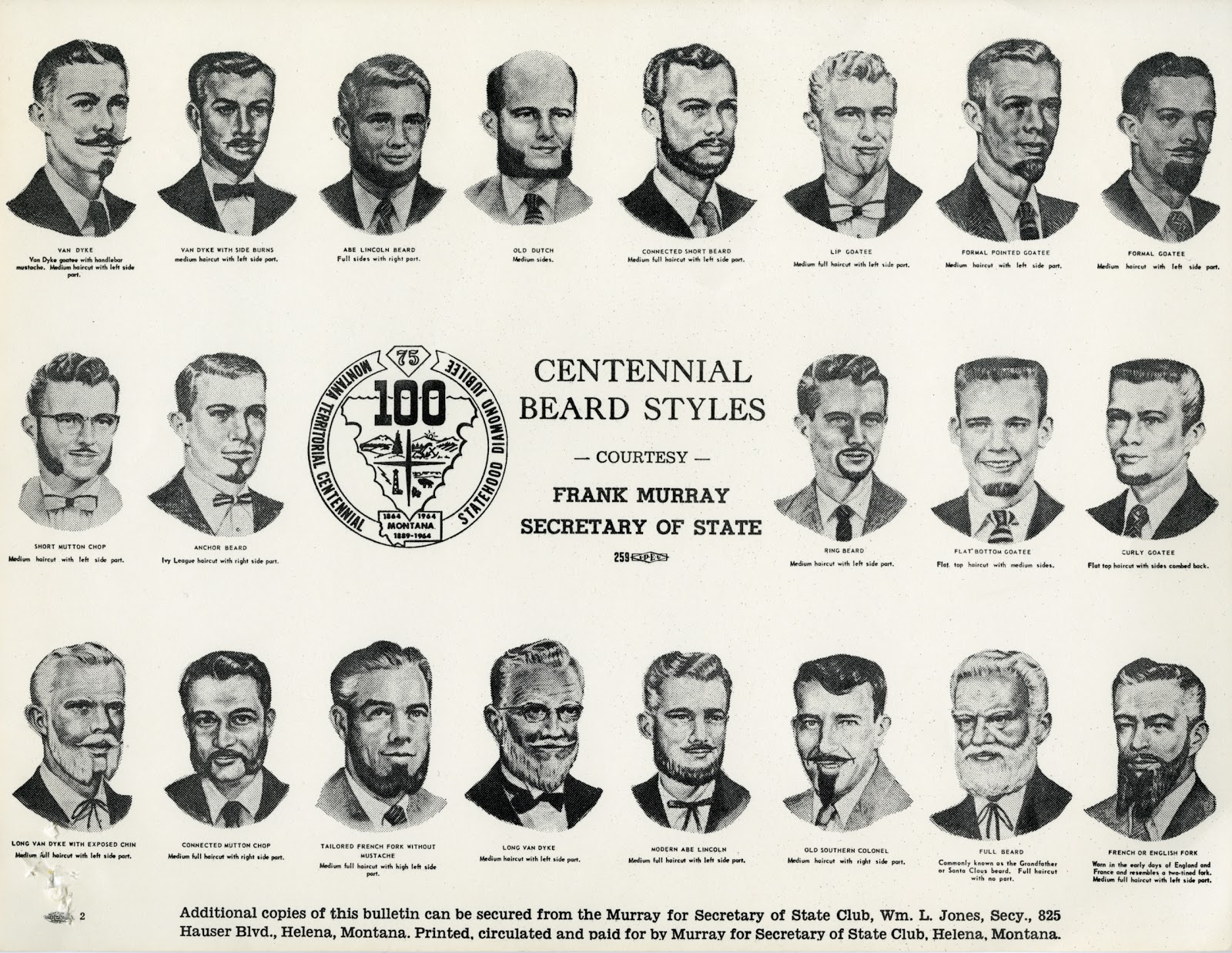
Attention, Men of Montana

Have you ever sported a Flatbottom? A Tailored French Fork? How about an Old Southern Colonel? While exploring our vertical file on the 75th anniversary of statehood in 1964, I discovered that the Junior Chamber of Commerce marked the occasion in a singularly masculine way: its members committed to raising a beard in an authentic historical style.


Bulletin: Centennial Beard Styles Courtesy of Frank Murray Secretary of State, Montana Territorial Centennial Statehood Diamond Jubilee
Bulletin: Centennial Beard Styles Courtesy of Frank Murray Secretary of State, Montana Territorial Centennial Statehood Diamond Jubilee, 1963, in the vertical file Montana Territorial Centennial 1964, 1.


They may have been inspired by this illustrated guide from 1963, where at least some of the whiskers are drawn on. By the way, vertical files are named for the tall cabinets in which they're housed. These folders of clippings and printed ephemera consume 42 file drawers (121 feet) in the Research Center and are open for public browsing.