December 13, 2018

Joe Scheuerle and His Remarkable Indian Gallery

by Jennifer Bottomly-O'Looney, MHS Museum Senior Curator


Joe Scheuerle and His Remarkable Indian Gallery—which opened in the Montana Historical Society’s Lobby Gallery on September 6—features the remarkable work of portraitist Joseph G. Scheuerle (1873–1948). Helena’s Magpie Drummers and Dancers provided entertainment for this special opening, which was generously sponsored by the Montana Bankers Association Education Foundation.

Image by Tom Ferris, MHS Photographer
 Born in Austria to German parents, Scheuerle, at ten years of age, moved with his family to Ohio, where he eventually studied at the Cincinnati Art Academy. Beginning in 1909, he made many visits to Indian reservations in Montana and across the West, where he produced exceptional portraits that were, in his own words, “all finished and done honestly and carefully from life and on the spot.” Throughout his career he created more than two hundred portraits, and established close friendships and rapport with his models. 


Image by Tom Ferris, MHS Photographer
In addition to the carefully finished portraits, Scheuerle often provided fascinating, whimsical sketches and commentary on the back of the canvases. Today, these provide invaluable insight into the lives of the people he was painting. Through the master craftsmanship of MHS preparator Todd Saarinen, many of the works in the exhibit are displayed so that both sides can be seen. Joe Scheuerle and His Remarkable Indian Gallery is scheduled to run through December 2019. 


Image by Tom Ferris, MHS Photographer
Joe Scheuerle and His Remarkable Indian Gallery is made possible through generous donations of the artist’s work from Joe Scheuerle’s grandson Bill Grierson and his wife Pat, and from collectors Alfred K. Nippert Jr. and Kathye H. Nippert,, who traveled from Ohio to attend the opening.

Image by Tom Ferris, MHS Photographer


November 22, 2018

#NativeAmericaHeritageMonth


For November and #NativeAmericanHeritageMonth, we have compiled, and would like to share with you, some great online resources for researching Native American history, culture, and genealogy.

Much of the following was taken from Martha Kohl’s Educator listserv. If you are interested in joining the listserv, you can find more information about it here: https://mhs.mt.gov/education/Forms/subscribeMHHElistserv

And, check out the listserv itself to get some awesome resources for teachers http://teachingmontanahistory.blogspot.com/

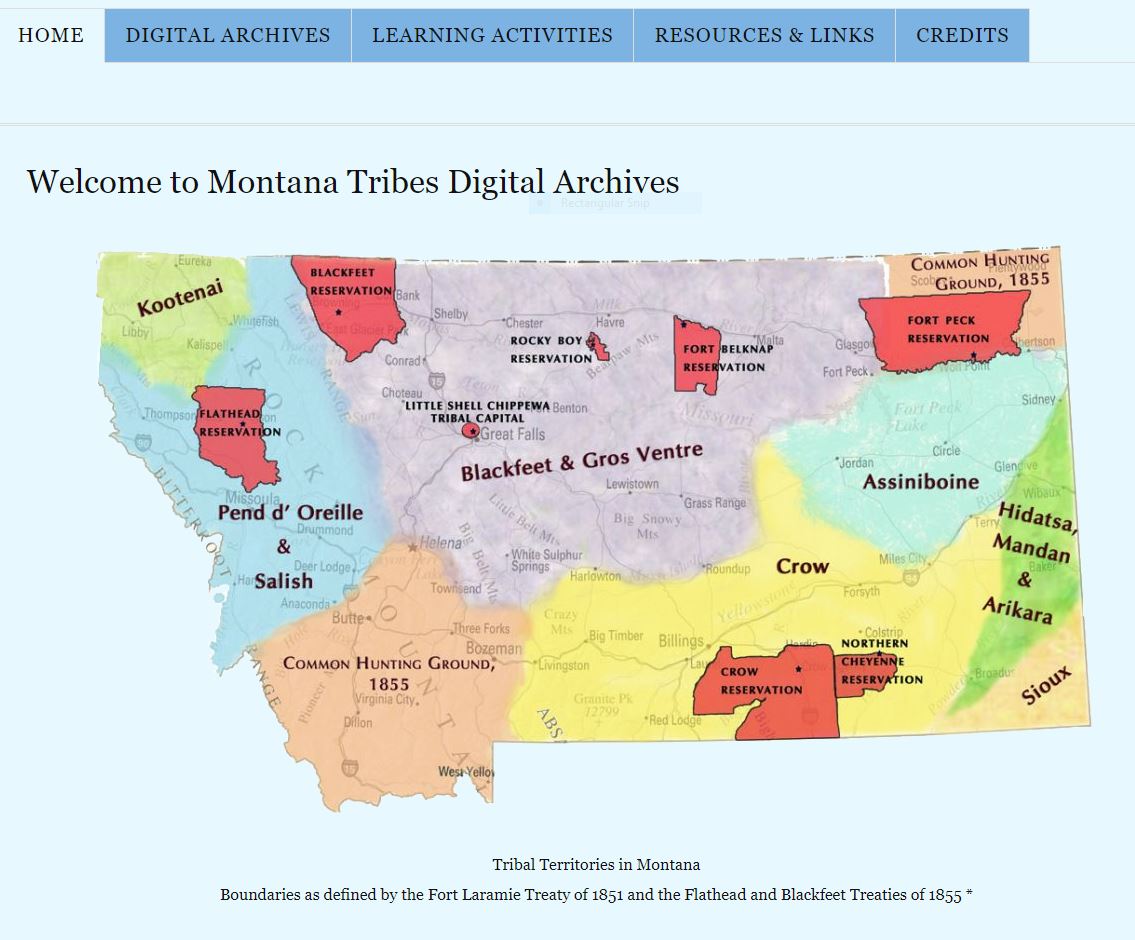
Did you know? Montana Tribes.org  has updated its activities and resources; and is now mobile friendly.

Every year, the University of Montana’s School of Journalism publishes Native News, an annual look at issues facing Montana’s tribes. The 2018 edition addresses the topic of self-governance. One article visits Rocky Boy High School’s Helping Hands Program, while another article visits the Dakota language program at Fort Peck Community College. 

Native Land is a site that maps indigenous territories in the U.S. and Canada. It is, as its creator explains, "a work in progress." There are some things that may not ring true for Montana tribes (for example, the Salish and Kootenai don't have distinct territories on the map.) But, it is a useful tool for sparking discussion and worth checking out. Type in the name of your town and see what comes up.
 

And, we can always use more online maps: Tribal Nations Maps .

Below are a few new resources for learning and teaching more specifically about the Métis.

The first is 
The Métis of British Columbia: Culture, History, and the Contemporary Community. It's an online version of a DVD project created to help disseminate information on Métis history and culture that includes many short videos. There are two main sections: Culture, History, and Dance, and Music and Dance. Although it is from Canada, the material is relevant to Montana as well. 

Finally, from 
The Gabriel Dumont Institute's "Virtual Museum of Métis History and Culture." This site has so much material that it is a bit daunting. But, all of it is excellent information.


Native American Genealogy Online Resources:

·        Access Genealogy - Native American is a great portal to most other websites for Native American Genealogy and includes:
o   Land Patent information for:
§  The Crow Tribe 
§  The Flathead Tribe
§  The Assiniboine Tribe - only one listing.
§  The Blackfeet Tribe - only 22 listings; however, the Blackfeet tribe has their own database of individuals (see below)

o   Indian Census Rolls, 1885-1940 for:
§  All tribes 1885-1940, digitized, but not keyword searchable

o   Indian Schools, Seminaries, and Missions – NARA has links to these, also, but this looks easier to navigate and includes the Fort Shaw Indian School 1910 Census.
                       
·         Blackfeet Genealogy – launched in 2006, this is a great source for Blackfeet individual vital data.


 BLM Land Patents – search by state and county and name or legal land description.

·         Family Search - Native American sources – this is a great portal for most of the other links here. Search by record type and by tribe.

·         National Archives - BIA records  – Record Group 75
o   BIA Schools by state includes Fort Shaw Indian Boarding School in Montana and Carlisle Indian School in Pennsylvania
o    Tribal Leaders Directory  searchable directory for Tribal contact information

November 8, 2018

Helena’s Social Supremacy: A Shot Fired in the Capital Fight

by Sierra Ross, MHS Research Center Library Assistant

The fight between Anaconda and Helena to become state capital is often portrayed as a knockout match between the larger-than-life mining millionaires Marcus Daly and William A. Clark. However, the satirical pamphlet “Helena’s Social Supremacy” shows how the capital fight was historically characterized as a matter of social class and local pride as well. As you can imagine, this led to some highly personal jabs.

The so-called Helena Capital Committee wrote “Helena’s Social Supremacy” as a mock sequel to the legitimately pro-Helena pamphlet “An Address to the People of Montana.” They sought to make Helena look ridiculous through excessive compliment, beginning their sarcastic endorsement with the following quote:
“That Helena is the social as well as the commercial, financial, agricultural, metallurgical, meteorological, geographical, astronomical, geological, theological, apostolical, political, intellectual, literary, educational, musical, theatrical, legal, medical, metaphysical, artistic, hygienic and esoteric center of Montana, is a fact which should admit of no dispute…”
A fashionable hold-up at the Broadwater Bar, Helena, MT. 
Even Helena’s most unsavory sorts were cut from a finer cloth than that of Anaconda. The Committee informs us, “Helena’s criminal classes are uniformly courteous and gentlemanly, never doing more injury to your person or feelings than the necessities of the occasion absolutely demand.” A robbery at the Broadwater Bar provided the bulk of their evidence. 

The Broadwater Bar hold-up, as reported in the Helena Herald, August 18, 1894.
In addition to satirizing Helena’s well-to-do, the authors played on the Anaconda working class’s existing feelings of resentment. An entire chapter of the pamphlet is devoted to snubbing Anaconda miners from their big feet to their dirty coveralls. Another chapter blames Anaconda’s benefactor, Marcus Daly, for everything from forest fires to the assassination of French president Sadi Carnot. The grievances of Helena supporters seemed to have no end: 
  “Anaconda is lamentably lacking in tally-hoes, four-in-hands, drags, waxed floors, dress suits, Browning clubs, theosophical societies, ceramics, art coteries, eight-course dinners, ten-button gloves, skirt dancing and other social facilities.” 
 “It is impossible to walk the streets of Anaconda without seeing workingmen and their wives and children, and when the streets are crowded one cannot escape brushing against them.”.
 “…the thick, nauseous fumes of corned-beef and cabbage settle over the town like a pall…”
 “Anaconda allows no Chinaman within her limits, and all laundry work must be sent to establishments conducted by high-priced American citizens.”
“Neither Marcus Daly nor any other citizen of Anaconda has ever asked Helena’s permission to live.”     
The Committee also provided vital statistics of comparison to convince its most skeptical readers, including the number of closet skeletons, breastfeeding mothers, and ladies who gave high fives. 

Mock statistics comparing Helena and Anaconda.
As much as I’d like to imagine 2,731 ladies high-fiving each other after Helena became the state capital in 1889, the high five in question most likely refers to a card game also known as Cinch. A disappointment for sure, but you can’t win them all.

 _______________________________________________________________________________

Helena Capital Committee. “Helena’s Social Supremacy: Montana’s Center of Fashion, Refinement, Gentility, Etiquette, Kettle Drums, High Fives, Progressive Euchre and Mixed Drinks.” Helena, Montana: Helena Capital Committee, 1894.


Newby, Rick. “Helena’s Social Supremacy: Political Sarcasm and the Capital Fight.” Montana: The Magazine of Western History 33, no. 4 (Autumn 1987): 68-72.


October 25, 2018

A Unique View of the Yellowstone Valley

Kelly Burton
MHS Film Archivist


A procession featuring members of the Crow Indian Tribe
 and local Catholics, near Pryor, ca. early-1930s.
The Montana Historical Society’s 45th annual conference was recently held in Billings, and the theme for this year’s event was “history from the Yellowstone Valley.” Conversations at the gathering inevitably addressed individuals that had made significant contributions to the history of Billings, and “Snook” was one of the family names that came up repeatedly among attendees. Earl Snook was a painter and decorator from Ohio who moved to the Fort Peck area when it was opened to homesteaders. Earl lived and worked on ranches in the Musselshell area until he was married in California in 1909 to his wife, Eleanor. The couple soon opened a paint and wallpaper shop in downtown Billings, which eventually expanded to include artist supplies, books and model airplanes. In the 1930s, the Snooks began acquiring what would become a sprawling 800-acre ranch along the crown of Sacrifice Cliff on the east side of Billings. Maintaining both the ranch and Snook Art Company in Billings, the family began to collect art and forge acquaintances with artists and writers such as Will James, Ernest Hemingway, Hans Kleiber, Bell Rock, Joseph Henry Sharp, and Joe DeYong.

Man riding a camel in the Shriners parade, downtown Billings, ca. early-1950s.
Virginia Snook, the only child of Eleanor and Earl, was born in Billings on June 6, 1911. After departing for Seattle in 1936 to attend Cornish School of the Arts, Virginia returned to Billings in the late 1930s to work in the family store and continue strong relationships with regional artists. After many decades of collecting artwork and supporting local creativity, Virginia was encouraged by Donna Forbes of the Yellowstone Art Museum to make a gift of the family’s collection. The friendship the family enjoyed with celebrated western artist and writer Will James is evidenced by the museum’s Virginia Snook Collection, which represents the largest collection of James art in the world. Virginia passed away on September 13, 2000 at the age of eighty-nine, and the family business closed in 2001 after serving the Billings area for almost a century.

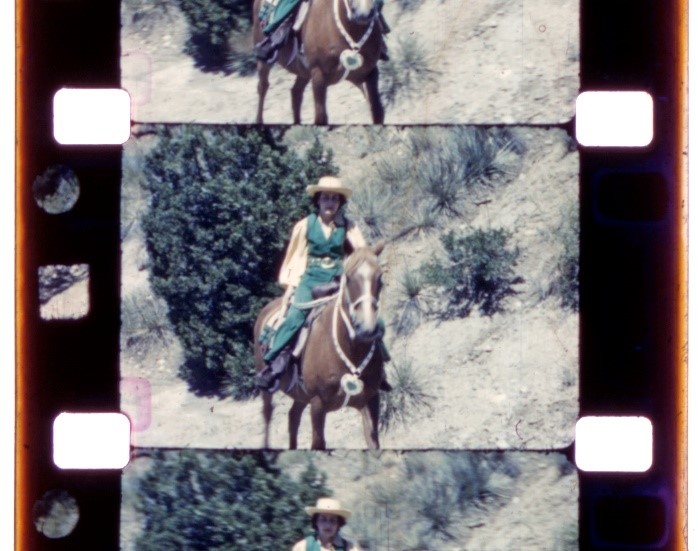
Virginia Snook on horseback, ca. early-1940s.
In 2014, a collection of motion picture films created by the Snook Family was donated to the Historical Society by Marjorie Brown – Virginia’s longtime friend – on behalf of the Snook Estate. The collection consists of forty-two reels of 16mm motion picture film, and it serves as a dynamic document of life in the Yellowstone Valley from the early 1930s to the early 1950s. Highlights from the Snook Family collection include regional fairs and rodeos, parades, Snook ranch activities, gatherings on the Crow Indian Reservation, horse auctions, equestrian quadrilles, and images of the cliffs and canyons around Billings. The family also documented several trips away from their familiar Billings surroundings, including a pack trip to the newly-established Grand Teton National Park ca. 1931, a visit to California ca. 1932, and the bullfights and architecture of Mexico ca. 1945.

Senator Burton K. Wheeler speaking
at a Billings area fair, ca. mid-1940s.
Earl Snook appears to have enjoyed a unique relationship with members of the Crow Nation, as is evidenced from several important films from this collection. Plenty Coups lived from 1848-1932, and he was the Ashbacheeítche – or “chief of the camp” – of the Mountain Crow Band of the Crow Nation. Plenty Coups began building the log homestead seen in the Snook film on 320 acres of Crow Indian Reservation land near Pryor, Montana in 1884, and in 1928 he and his wife presented 189 acres of his land in trust to Big Horn County for what is now Chief Plenty Coup State Park. Earl filmed a gathering of Crow Indian Tribal members at this homestead in the early 1930s, with several of the chief’s notable log structures serving as backdrops. In addition to this meeting, Earl also filmed a procession near an unidentified Catholic mission in the Pryor area. This procession footage shows members of the Crow Nation and the Catholic church walking together down a rural road and gathering in front of a small area mission. Given the date of the film and the fact that Earl Snook took still photographs of the funeral of Chief Plenty Coups in 1932 (MHS photograph collection Lot 35), these gatherings may have represented tributes to the life of the Crow chief.

Gathering at the home of Chief Plenty Coups on the Crow Indian Reservation, ca. early-1930s.
One of the more novel events to happen on the Snook ranch was the filming of battle scenes for the Paramount Pictures film Warpath. The film was directed by Byron Haskin, and it stars Edmond O’Brien, Dean Jagger, Forrest Tucker, Harry Carey Jr. and Polly Bergen. Based around a Seventh cavalry detachment scouting expedition out of Ft. Lincoln near Bismarck, N.D. in 1876, the film portrays the events leading up to the tragic Battle of the Little Bighorn. The film itself was made with the cooperation of the Crow Indian Tribe, Montana Film Office, City of Billings, Yellowstone County Fair Board, and the U.S. Bureau of Indian Affairs, and many of the battle scenes were staged on the Snook ranch. Earl Snook shot 30 minutes of home movie footage during the filming of Warpath, a fact that was noted in one of the many newspaper articles covering the production: “Earl Snook, on whose ranch most of the battle scenes are being taken has been a continuous visitor on the set. He has been taking his own action movies along with the studio camera.” (Billings Herald, September 7, 1950) Billings also hosted the world premiere of Warpath at its Fox and Babcock Theatres in 1951, though this party remains sadly undocumented in the Snook Family films.

Harry Carey Jr. and Polly Bergen on the set of the Paramount Pictures feature Warpath, filmed in 1950.


October 11, 2018

A Taste of the Past: Gathering Montana’s Food Heritage


by Molly Kruckenberg, MHS Research Center Director

The Montana Historical Society’s work extends beyond the borders of our doors and reaches out into every corner of Montana.  Recently, MHS staff spent time in Sidney, Montana learning about the food history and heritage of that area.
MSH students digitize food-related materials at the Pella Lutheran Church in Sidney.
Image by Tom Ferris, MHS Photographer

On Saturday, September 15th, a team of historians and students from the Montana Historical Society and the Center for Western Lands and Peoples at Montana State University hosted "A Taste of the Past: Gathering Montana's Food Heritage" in Sidney. Residents of Richland and Roosevelt counties were invited to bring traditional recipes, community cookbooks, historic photographs and documents of food-related events, menus, records of home demonstration clubs, and artifacts related to food preparation and preservation to share with the historians and students. While stories were shared with historians, the MSU students scanned and gathered information about the documents and artifacts that were brought to this event. During the day, MHS and CWLP staff presented programs on Montana food history and preservation techniques for cherished artifacts, cookbooks, and photographs.  
Recipe card library with handwritten recipes from the Lambert area,
courtesy of the Lambert Historical Society.
[Image by Tom Ferris, MHS Photographer]
Area residents brought in items ranging from cookbooks to bread rising bowls to recipe cards and krumkake bakers. A 1920s era Sidney Ladies Guild Cookbook showed ads from local businesses, as well as favorite recipes from women of the Ladies Guild. A set of three krumkake bakers, dating from the early twentieth century to the early twenty-first century showed continuity in area food traditions.  A group of items containing a large wooden bowl, paddle and mold illustrated how butter was packed into one-pound blocks for use.  These, and the many other recipes and artifacts that were documented, speak broadly to the history of the region’s local food customs.

Wooden bowl, paddle, and butter mold that belonged to Mary Folvag,
courtesy of Debra Rasmussen.
[Image by Tom Ferris, MHS Photographer]
The digital images and information collected at the event will be used to study Montana’s food heritage and history in many ways.  The images and accompanying stories will eventually be made available on the Montana Memory Project (www.mtmemory.org), where they can be freely used by the public for research and enjoyment.  Additionally, the historians involved in the project will return to Sidney in the spring of 2019 for a public program based on the stories and information gathered at the event. 
MHS Reference Historian, Zoe Ann Stoltz, spoke with many
event participants about Montana's food history and heritage.
[Image by Tom Ferris, MHS Photographer]
This project was made possible through a grant from the National Endowment for the Humanities, as well as through the partnership of many institutions:  Center for Western Lands and Peoples at Montana State University; Sidney-Richland County Public Library; James E. Shanley Tribal Library at Fort Peck Community College; MonDak Heritage Center; Montana State University Library;  and the Montana Memory Project.