November 6, 2015

Wikipedia and Montana History: Engaging the World's Largest Encyclopedia

By Jeff Malcomson, MHS Photo Archivist

When we need that quick information these days many of us turn to the Internet, and often our searching leads us to Wikipedia. With over five million separate articles in English alone, the popular Web-based encyclopedia has been around since 2001 and is now a staple of any Internet search. According to Wikipedia's own article about itself, content is developed "collaboratively by largely anonymous volunteers who write without pay." With over 26 million registered users, or "editors," many hands have built the resource that most of us use almost every day.

One of the main issues in using Wikipedia over the years from a research perspective is the perceived unreliability of the content. Many wikipedia articles are works-in-progress, with some more finished than others. The articles are only as good as the editors' knowledge of the subject and the sources that inform them. Many articles on people, places, and things in Montana's history are still awaiting creation, or in great need of improvement. This realization led me last summer to sign-up for a workshop called "WikiWrite." I wanted to use my knowledge of Montana history and the availability of numerous sources here at the MHS Research Center to improve Wikipedia articles on Montana history topics. That half-day at the MSU Library in Bozeman opened my eyes to the task of editing Wikipedia and gave me the time to learn the basics.

http://en.wikipedia.org/wiki/Wikipedia:GLAM/US
One thing I learned immediately was that Wikipedia itself had a substantial outreach to professionals like me in cultural institutions like the Montana Historical Society. Known as the GLAM-Wiki Initiative, which stands for Galleries, Libraries, Archives, Museums with Wikipedia, this effort seeks to engage cultural institutions with Wikipedia, to build relationships to add content in the form of article text and digital versions of historical documents, photographs, maps, and works of art.

As Montana Historical Society staff we seek to promote the knowledge of Montana history to the widest possible public, so it seemed natural to explore the use of Wikipedia to accomplish that end. One way to promote the improvement of a particular subject area on Wikipedia is to hold an edit-a-thon. Just like it sounds, this is an event where interested editors get together for part of a day and add content and improve articles usually surrounding a theme. Taking inspiration from our Women's History Matters project, we decided that our first edit-a-thon should focus on creating or improving articles on women in Montana history.

Members of the staff of both the Montana Historical Society and the
Montana State Law Library participate in the first Wikipedia edit-a-thon
 held in Montana this past August in the MHS Research Center.
We hosted this initial event in the MHS Research Center on August 31. It was open to MHS staff and the staff of the Montana State Law Library. Though several staff members assisted in planning and supported the edit-a-thon, we had five active "editors" learning how to edit and improve articles. Together we created four new articles on Montana women Dolly Akers, Helen P. Clarke, Rose Hum Lee, and Beth Baker and improved two other articles on Ella Knowles Haskell and Mary Fields. We also created a "project" page where we placed info about the event and helpful links for our on-going effort to improve Wikipedia entries on Montana history.

As a first engagement with Wikipedia this event was a success.  In the future, we hope to continue to hold edit-a-thons every four months and draw in more MHS staff, volunteers, and even interested members of the general public to participate in this project. Watch for information about our next edit-a-thon coming in early 2016 and, in the meantime, investigate how you can work to improve "the free encyclopedia that anyone can edit."


October 16, 2015

The Montana National Guard's service on the international stage


by Katey Myers, Summer Intern, MHS Library

The military is often seen as the four main branches: Army, Air Force, Navy, and Marine Corps; while the National Guard is sometimes seen as a separate entity. This is far from the truth. The Montana National Guard has not only consistently played a role in the protection of the state, but also served on the national stage. The Montana Territorial Volunteers were established in 1867, over twenty years before Montana became a state. The First Montana Militia, later known as the Montana National Guard, would serve well beyond Montana’s borders.

During the Philippine-American War in the late 1890s, the 1st Montana Volunteer Infantry Regiment was called into federal service for the first time. Beginning as the 1st Regiment of Infantry in the Montana National Guard during the 1880s, the Volunteer Infantry was in service from May 1898 to October 1899. When the Volunteer Infantry was mustered out of service after the campaign, many of the men’s terms of enlistment were up. Very few - 114 infantry and cavalry soldiers - remained on the National Guard rosters.

With this small number serving in the Montana National Guard, efforts to rebuild the Guard were a priority for Adjunct General Charles English. A lack of funding and support from the state at the time led to inadequate equipment, uniforms, and training. According to English in Orlan Svingen’s Splendid Service: The Montana National Guard, 1867-2006, Montana guardsmen were facing obstacles that jeopardized the militia’s existence due to these inadequacies. With sufficient support from the state, English believed that “there is no reason the Montana National Guard should not rank first…and lead the way to the founding of a National Military Reserve.”


2nd Montana, 163rd Infantry
leaving for France from Helena, MT
October 24, 1917, World War I
MHS Photo Archives # 953-646
At the turn of the twentieth century, legislation from the federal government gave the National Guard a more permanent role in the military on a national level. The Guard’s annual appropriation was raised and equipment was issued by the federal government. In return for the appropriation, the Guard was expected to become a federal reserve force. Due to this change in the duties of the Guard, the Montana National Guard was reorganized and designated the 2nd Montana Infantry Regiment in 1901. Companies were formed all over the state and the Guard, with its new equipment, began a training regimen as well as participated in camps with the Army.

In June 1916, the 2nd Montana Infantry saw their first national service when the regiment was mobilized for guard duty during the Mexican border conflict after the Mexican Revolution. The regimental commander, Colonel “Dynamite Dan” Donohue, was rampant with his recruitment at the time and held extremely high standards for his men. According to Col. Donohue in Splendid Service, new recruits “needed to be from 5 feet 4 inches to 6 feet three inches in height, weigh between 120 and 190 pounds, be able to speak, read, and write English, have generally good health, and be an American citizen.” After fulfilling these requirements, men were then subject to a rigorous training schedule during their time at Fort Harrison.

In early July 1916, the regiment set up camp in Douglas, Arizona. The 2nd Montana Infantry cleared their camp of vegetation and leveled the ground before tents and other structures were laid out in an orderly fashion. While tents were the earliest structures to be erected, a lack of building materials made it difficult to build anything such as mess halls, bathhouses, or any other structures. During their first month of border duty, the Montanans spent most of their time under sniper attack but only two fatalities occurred, both of which were health related.

The Montana Bugle, July 15, 1916
Printed in Douglas, Arizona
Recreational activities were a key part to the daily lives of the men as these activities were used to break up the monotony of continual patrols and afternoon thunderstorms. Chaplain McMullen obtained a large recreational tent for the troops where books and other publications, stationery, games, a piano, an organ, a phonograph, and a moving picture machine were available. During this time, The Montana Bugle was first published. A four page, weekly newspaper, The Montana Bugle (right - copy of one issue) contained news stories about the different companies and the border area, national stories, orders from Col. Donohue, camp gossip, and jokes. This paper was read by citizens in Montana as well as Guard members stationed on the Mexican border.

After only a few months in federal service, the regiment was demobilized at Fort Harrison in October 1916. The 2nd Montana Infantry would only have a few months of peace before once again the call to service was given. In March 1917, the regiment was mobilized in preparation for service in Europe. However, due to the labor unrest in Montana, the Guard began its active service protecting industrial and commercial enterprises that were experiencing strikes.  In July, the Guard was ordered to prepare for duty overseas. As the War Department integrated the National Guard into federal service, the 2nd Montana Infantry was re-designated as the 163rd Infantry Regiment, 41st Division.

Commemoration for the 163rd Infantry
MHS Library Poster P-697, 1917
The early months of the regiment’s service during World War I included training with the Army in camps across the U.S. After being sent overseas in December, the 41st Division was relegated to replacement and depot status. The 163rd was broken up as men were moved to various units. From there, the men continued their training in areas throughout France as well as serving along the front lines. In March 1919, the 163rd returned home.

During the 163rd's service in Europe, 39,276 Montanans served in the armed forces - including the National Guard, draftees, and regular enlistees - out of a state population of 496,131.

After World War I, the pre-war National Guard no longer existed. The Montana National Guard reformed in the 1920s and went on to serve the nation once again in World War II. 


________________________________________________

Sources:

2nd Montana Infantry. Collection #1887. Montana Military History Museum. Fort William Henry Harrison.

Shore, Chester K. Montana in the Wars. Miles City MT: Star Printing Company, 1977.

Svingen, Orlan J. Splendid Service: The Montana National Guard, 1867-2006. Pullman WA: Washington State University Press, 2010.

October 7, 2015

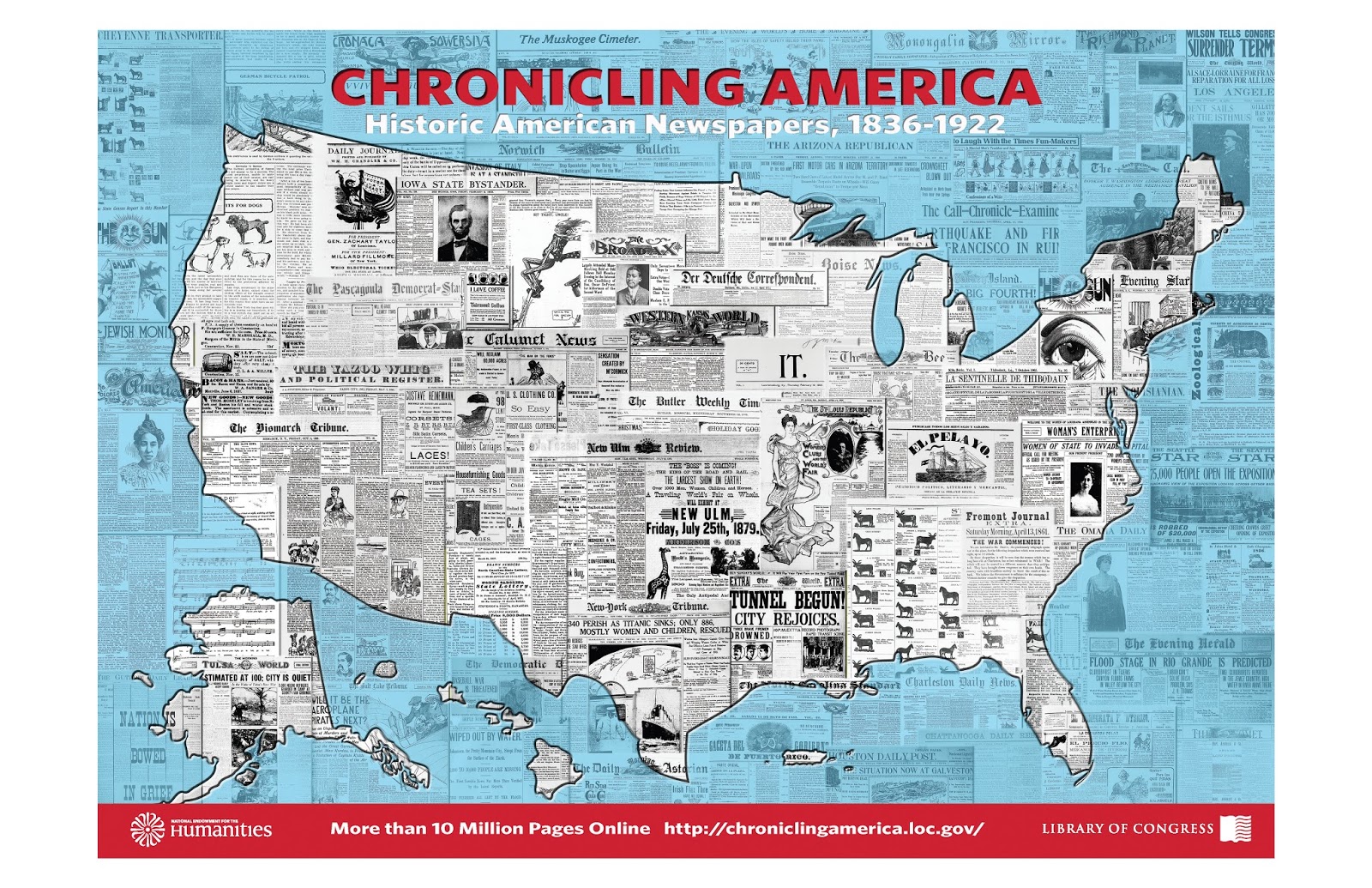
Chronicling America Hits 10 Million Pages!

By Natasha Hollenbach, Montana Digital Newspaper Project Assistant

From 2009-2015, the Montana Historical Society has been a participating member of the National Digital Newspaper Program (NDNP), which is a joint program between the National Endowment for the Humanities, the Library of Congress and state institutions.  After three grant cycles, MHS has contributed just over 268,000 pages from 56 Montana newspapers to the Chronicling America website.

Today, Chronicling America past the 10 million page milestone. Containing newspapers published between 1836-1922 from 38 states and territories, Chronicling America is a tremendous resource for historians, students, genealogists and anyone else interested in our nation's history. Usually when we talk about Chronicling America, we focus on Montana newspapers. However, in celebrating this joint effort, it seems appropriate to showcase how valuable other states' newspapers can be in researching Montana's history and people.

From the founding of Montana territory to the Speculator Fire, major Montana events have made national news. 
Jeffersonian Democrat
Chardon, Ohio
July 8, 1864


The Indianapolis Journal
Indianapolis, Indiana
October 26, 1894
        
The Evening Current
Carlsbad, New Mexico
June 9, 1917


They have followed our wages, population and weather.
Maui News
Wailuku, Hawaii
January 10, 1919
Daily Capital Journal
Salem, Oregon
August 6, 1917


The Evening Current
Carlsbad, New Mexico
October 17, 1917


National newspapers also highlighted Montana's natural beauty and helped advertise our national parks.


New York Tribune
New York, New York
January 17, 1909
New York Tribune
New York, New York
October 22, 1919


St. Louis Republic
St. Louis, Missouri
June 12, 1904


Travel has always been a matter of interest to newspapers. The Butte Inter Mountain hosted a popularity contest in 1904 with the winners going to the World's Fair in St. Louis where they apparently made an impression on the local newspaper (right). In 1915, the Honolulu Star-Bulletin commented on a group of girls from Butte traveling in Hawaii (below).


Honolulu Star-Bulletin
Honolulu, Hawaii
April 3, 1915


Meade County News
Meade, Kansas
July 19, 1917

Genealogists use newspapers to find family events: births, deaths, marriages, etc. Since researchers usually look in the newspapers where their ancestor lived, it is easy to overlook the possibility of finding them in other states. For example, to the right is a blurb from a Kansas paper, where a man currently living in Butte has arrived to visit his father. If you search the Kansas paper further, you find that this is the town where he was raised. Sometimes searching the newspapers outside of Montana leads to connections with other people and places.

Why don't you go to Chronicling America (http://chroniclingamerica.loc.gov/) and search for your favorite Montana event or person and see what other states' newspapers were saying about them?  You never know what you'll discover in historic newspapers. 


September 25, 2015

Homicide in Montana Territory: An Initial Look

by Jeff Malcomson, Photograph Archivist

Studying homicide in Montana's territorial period opens a window into the society being constructed during Montana's early period from 1864-1889.  It gives context to the popular story of vigilantism in
Montana, and emphasizes the level of violence, and particularly lethal violence, endured by Montana's early residents.

While many homicides related to on-going vigilante justice in both Helena and surrounding Edgerton County (changed to Lewis and Clarke County in 1869) and the farming areas of Gallatin County around the fledgling town of Bozeman, property disputes and personal quarrels also led to lethally violent encounters.  The ubiquitous nature of firearms in territorial Montana also meant that many intense disputes would lead to bloodshed.

The tables included here, taken from a presentation made Sep. 26 at the Montana History Conference in Bozeman, show the statistics gathered through initial research into homicide in Montana Territory.  The standard among criminologists and historian's of homicide is to calculate the homicide rate as a figure per 100,000 residents.  The threshold for a high rate of homicide, according to one expert, is 9 homicides per 100,000, and a rate of 34 per 100,000 is considered extremely high.  Through the use of newspaper accounts in the Montana Post from 1864-1867 and coroner's inquest records from early Lewis and Clarke County, we can see astronomically high rates of homicide in the earliest days of the Territory.  We also see reduced rates of lethal violence in the latter 1880s in Lewis and Clarke County approaching that 9 per 100,000 threshold as statehood approached for Montana.

More research will follow, and a more complete picture of the history of lethal violence in Montana Territory should help us to understand the widespread violence found in our early history and why it occurred.

September 11, 2015

Evelyn Cameron and L.A. Huffman Photographs on the Montana Memory Project

by Tom Ferris, Archival Photographer


Hugh and Elinor Baker (PAc 90-87 G016-005) Evelyn Cameron, photographer
The Montana Historical Society invites you to view our latest addition to the Montana Memory Project. With the help of a grant from The Montana History Foundation we have been able to digitize and upload 1,300 photographs and records from the Evelyn Cameron and L.A. Huffman collections. As two of our most iconic and dynamic photographic collections, they showcase many aspects of life in Montana from the 1880’s to the 1920’s.

Layton Alton Huffman began his solo photography career as the post photographer at Fort Keogh after working for F.J. Haynes, official photographer for Yellowstone National Park, in Fargo, North Dakota. He opened his own studio in Miles City in 1879 and became well known for photographing cowboys, Indians, soldiers, and the last of the buffalo hunting in Eastern Montana.

L.A. Huffman Photographs
Red Sleeve (#981-579)
Montana Man Hunters of the 70's (#981-167)


Killing of a Buffalo (#981-011)

Evelyn Cameron came to Montana in 1893 with her husband Ewen intending to breed horses  for shipment back east and to Europe. This venture failed and Evelyn pursued her career in photography as well as running the Eve Ranch. Her photographs capture the lives of people and friends around Terry and Fallon, Montana in a candid and direct manner. They also document the changing times from the early ranching scenes to the arrival of the railroad.

Evelyn Cameron Photographs
Baker's Shearing Pens (PAc 90-87 G004-004)
Janet Williams on Yalu (PAc 90-87 G003-005)


The majority of the images from each collection were scanned at high resolution from original negatives which are mostly 5”x7” to 8”x 10” glass plates and nitrate negatives. Some are smaller format negatives and a few images were made from vintage prints if the negatives are not in our collections. It is great to get these original materials scanned as digitization is one of the most useful preservation tools available to us - once the original materials are properly stored, stabilized, and cared for. Here is an example of a scanned negative of Camerons’and the image made for use from it.
Bill Foght and Cap Baker
(PAc 90-87 L004) Negative Image
Bill Foght and Cap Baker
(PAc 90-87 L004) Positive Image


As important and informative as the photographs themselves are,  the records and information that accompany them   provide key information for researchers and  other interested viewers. The grant funding provided by the Montana History Foundation enabled us to hire contract workers who made the addition of this data possible. The images are also being uploaded to the OCLC Digital Archive (Online Computer Library Center) for long term preservation. In addition, having these images available online makes them much more accessible to those who can not travel to the Montana Historical Society.
We hope to post more information about these photographers and others in our collection in the near future but for now here are a couple of links which will take you directly to the Cameron (Cameron Photographs MMPand Huffman (Huffman Photographs MMP) images on the Montana Memory Project, where you can also explore other facets of Montana History from many institutions across the state. Happy Trails!