May 17, 2012

Religious texts at the Montana Historical Society

Guest post from Allison Badger, a contract cataloger, who has been working at the Research Center for the past 6 months.
As a cataloger I deal with a variety of materials. Some are interesting and some not so much. A few weeks ago, I came across some items that definitely fell into the interesting category: the Montana Historical Society’s collection of Bibles and other religious books. While most of this collection consists of family Bibles, it also includes Catholic prayer books, a Jewish Bible and Methodist hymnals.
     
On the left, The Holy Bible, containing Old and New Testaments. together with the Apocrypha (undated, owners unknown). On the right, Tresor des ames pieuses ou divers moyens d'atteindre la perfection Chretienne, published in 1869, owned by Philomine Rouleau.
Before they came to the Montana Historical Society, many of these items belonged to people who played a role in Montana’s history. Materials of interest include Granville Stuart’s The New Testament of Lord Savior Jesus Christ (1881), Governor Samuel Hauser’s family Bible (1853) and a Bible presented to Governor Forrest H. Anderson on the one hundredth anniversary of the Montana ministry of Methodist circuit-rider Brother William W. Van Orsdel. This collection also contains items that were owned by less-well known Montanans. These books include French Catholic prayer books that belonged Philomine Rouleau and James Rodda’s Hymns for the Use of the Methodist Episcopal Church (1872).

Interior pages showing Philomine Rouleau's notations.

Although the volumes themselves are fascinating, it’s the personal touches that truly set them apart. That is, many of the previous owners listed the marriages, births and of deaths of family members within the pages of these books. Some, such as the Hauser Bible, document several generations Hauser family. Others contain a lock of hair or four leaf clover or notes related to various Bible verses. One in particular, the Wood Family Bible, contains the signatures of the family members who owned this Bible.  

For a complete list of what is included in this collection, see the catalog record here. Then click on Catalog Record.

May 8, 2012

Attention, Men of Montana

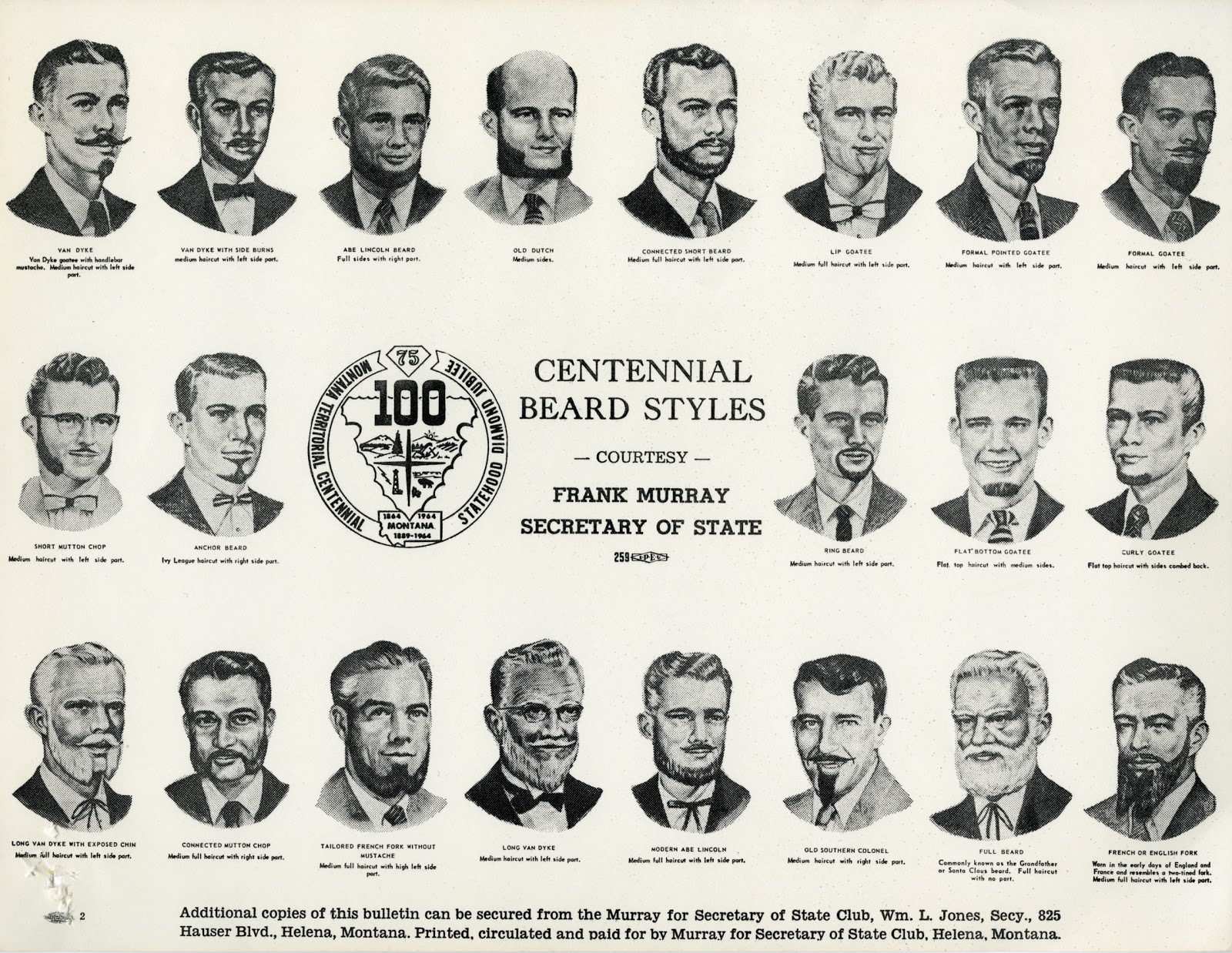
Have you ever sported a Flatbottom? A Tailored French Fork? How about an Old Southern Colonel? While exploring our vertical file on the 75th anniversary of statehood in 1964, I discovered that the Junior Chamber of Commerce marked the occasion in a singularly masculine way: its members committed to raising a beard in an authentic historical style.


Bulletin: Centennial Beard Styles Courtesy of Frank Murray Secretary of State, Montana Territorial Centennial Statehood Diamond Jubilee
Bulletin: Centennial Beard Styles Courtesy of Frank Murray Secretary of State, Montana Territorial Centennial Statehood Diamond Jubilee, 1963, in the vertical file Montana Territorial Centennial 1964, 1.


They may have been inspired by this illustrated guide from 1963, where at least some of the whiskers are drawn on. By the way, vertical files are named for the tall cabinets in which they're housed. These folders of clippings and printed ephemera consume 42 file drawers (121 feet) in the Research Center and are open for public browsing.

January 11, 2012

Treasures from the Library Collections at MHS

In 1886 the citizens of Helena established a free public library and in 1891 created a published catalog of their holdings. The earliest library catalogs in the United States date to the mid-1880s in Philadelphia. Prior to the advent of the card catalog patrons located books on the shelves using a printed catalog in book form. Books classified as History, Philosophy, and Science filled the shelves of early public libraries in Montana and across the nation. The images below depict these early catalogs.

Catalogue of the Helena Free Public Library.

In 1890 a wealthy mining man by the name of Charles Larrabee donated $10,000 to establish a lending library in Butte. By the date of this publication, the library advertised a collection of over 15,000 books. The catalog contained an alphabetical listing of authors with book titles and the Dewey Decimal number location. The Butte librarian, John F. Davies, explained that advertising was sold for the printed catalog to defray its cost and to build an acquisitions fund. The Butte Free Public Library also maintained a card catalog, and 3100 copies of the catalog were printed for distribution in the community.
Catalogue of Books in the Butte Free Public Library,
July 15, 1894. Published in Butte by T.E. Butler, 1894.

September 2, 2011

Ephemeral Summer

 This summer we had the pleasure of working with Sean Leahy, an intern from the Pratt School of Information and Library Science in New York. Sean's focus over his 8 week stay was the Library's Ephemera Collection. Sean worked on clarifying the organization of the collection, and on digitizing a sample of the collection. Below is an excerpt from his end of project report.

"Part archival object, part work of art, and part printed matter, the items that make up a collection of ephemera can be difficult to define and therefore difficult to organize and describe. Though the history of collecting ephemera is centuries-old, it is only in recent years that ephemera has become the focus of serious research. Particularly when investigating the social life and customs of a particular group, era, or region, examples of ephemera can illuminate what historians in the past have overlooked or obscured."
The Ephemera Collection dates to the 1980s and its primary focus is materials deemed to be fragile, rare, or unusual. Generally, the items are more than thirty years old and of some graphical interest. The collection is particularly strong in materials related to Helena. These range from political campaign materials to tourist information brochures, hotel menus to shoe store ads. The bulk of the items date from 1885 to 1910, documenting the end of the territory and the early years of statehood, as Helena grew to be one of the richest towns in the United States and an important destination along the Northern Pacific Railway. The strengths within the Helena materials are the programs from various social clubs, the extensive collection of theater programs, and the amazing variety of business advertisements. In addition to the Helena files, there are a number of folders devoted to tourism in Montana in general. The materials, many of which were published by the Montana State Highways Department, suggest routes, sights, and activities (mainly fishing) to travelers. These date mostly from between 1930 and 1950 and offer a researcher some especially interesting graphic material and a sense of Montana identity in the age of automobile travel, i.e., the last place to get a taste of the Wild West. Finally, there are two folders related to the Montana Club that contain a number of fascinating items. While the majority of the items are invitations to various events hosted by the Club (particularly their annual New Year’s Eve “Smoker”), they contain interesting caricatures of club members and humorous songs and toasts, all displayed on well-designed, nicely printed sheets.

We really appreciate the work that Sean did on this collection and hope that you find the collection useful in your research.

The Ephemera File Index can be found on the Montana Historical Society’s online wiki. To see more of the MHS Library ephemera collection, visit the MHS Library Collection on the Montana Memory Project.

April 8, 2011

Secrecy, war planes and belligerent nations


What do secrecy, war planes, and belligerent nations have to do with Montana? More than you might think. A recent research request put me on the trail of training planes sold to the Royal Canadian Air Force (RCAF) in 1939 and 1940. The request asked for confirmation of these planes being flown to Sweet Grass, Montana and then being pulled across the border into Canada. Newspapers proved to be the place to find this information. Using our subscription to Access Newspaper Archive I was able to find articles in the Lethbridge Herald that confirmed this had taken place. Then I started looking at similar dates in the Shelby Promoter and Great Falls Tribune. The first 5 planes crossed the border on November 19, 1939. Ten more followed within a week. The November 27, 1939 Great Falls Tribune ran a large article with several photos that detailed the plan. A small article in the Montana Standard on December 13, 1940 stated that 100 planes would be delivered to Canada through Great Falls. The U.S. Neutrality Act would not allow U.S. pilots to fly across a belligerent nation (Canada was at war with Germany) or allow for flight across the US by people from a belligerent nation. The North American Aviation Company was getting around the law by flying the planes to Sweet Grass, and then having them towed across the border by Canadian civilians. RCAF members could not touch the plane until it was firmly on Canadian soil. If they crossed the border into the United States they could be interned for the duration of the war. The cash and carry law was replaced by the Lend-Lease Act in March of 1941.

Learn more about the Cash and Carry amendment to the U.S. Neutrality act here: http://en.wikipedia.org/wiki/Cash_and_carry_(World_War_II)

Read about the Lend-Lease program and see the actual bill text here: http://www.ourdocuments.gov/doc.php?flash=old&doc=71