By Kirby Lambert, Outreach and Interpretation Program Manager
Sketchbook cover: Drawed by Elizabeth Strohl, Victor, Mont, 91 Years Old, Now Deceased.
Museums love to have the complete provenance, or history, of the artifacts in their collections. By knowing the “who, what, when, where, and why” associated with each item, we are able to gain a deeper understanding of the lessons that objects can teach us about our past. In spite of our best research efforts, however, sometimes it is simply not possible to uncover the untold stories about the materials we hold. Even so, items with little or no known story, can still educate and entertain us, while connecting us to the past in meaningful ways.
One example is the Lizzie Strohl sketchbook housed in our museum collection. This is what we know about the artist: Lizzie Buchanan was born in the community of New Chicago in Granite County, Montana Territory, on September 19, 1873. Her parents were Thomas and Luella Hatfield Buchanan. She married John Strohl in Deer Lodge on July 19, 1892. As reported in the New Northwest, the ceremony was held at the “Scott house” and was officiated by Judge Hartwell. The Strohls were farmers and had at least two sons—John, Jr., and George. Lizzie died on July 31, 1964, in Victor.
Dad Likes Jim; Susie Jane Likes Phillip So There is a Misunderstanding
These facts aren’t much to summarize a life of ninety-one years. No doubt Lizzie celebrated triumphs, suffered losses, loved her family, and endured the drudgery of hard work. For the most part, the sketches in her notebook document the quiet moments of daily life, with the chasing of a cattle rustler thrown in for a little excitement.
Clearly, Lizzie had no training in art and, most likely, only limited access to art supplies. So why did she choose to record her memories in this manner? And when did she create the drawings? At first glance, we might assume that this is the work of a child, but based on the presence of a car and the styles of some of the clothing depicted, we know that at least some of the images were not drawn before the 1920s when she was in her fifties. Or, maybe none of the scenes were executed until Lizzie neared the end of her life and she sought to record her fondest memories. We just don’t know.
These primitive drawings may always raise more questions than they answer but—for some of us at least—they still provide a heart-felt connection to the past and the lives of ordinary Montanans from long ago.
Noon HourJust a Pick NickFarmers Having a Chat Out in the WestIn the Rockies, at a Prospectors Camp in MontanaAfter Cattle Thieves in the RockiesElk in Montana, Near the Black [sic] RiverCattle on the Range Near Drummond, MontJust Sweet Hearts at their Meeting PlaceOut on the Home SteadA Hereford Cow from One of the Herds from Dinwall Ranch in the Flint Creek Vallie, Mont
The first quarter of calendar year 2020 started with a crush. In just three months, the Montana Historical Society Research Center added 425 linear feet of records to our archival holdings, greatly enhancing our labor history and corporate history collections. Now if you are wondering how much 425 feet is...think one football field plus four first downs and you get an idea of the size! Below are some of the highlights of these new materials now in our permanent collections.
Montana Public Employees' Association—80 linear feet dating between 1945 and 2017. While this is a stand-alone collection, it has intellectual ties to the Montana Education Association, Montana Federation of Teachers, and MEA-MFT records already held at by MHS.
Established in 1945 to promote a retirement system for public employees (state, county, and municipal), MPEA merged with MEA-MFT in 2018 creating the Montana Federation of Public Employees.The MPEA Master Contract has withstood the test of time as it commemorates its 44th year.MFPE-MDT Local 3511 Courtesy Local President David Krause
Montana AFL-CIO—285 linear feet dating between 1923 and 2016. This new donation fills in the Montana AFL-CIO collection already held by MHS: MC 341 Montana State AFL-CIO records 1896-2000.
Onsite storage of MT AFL-CIO recordsTailgate preliminary processingJeff Malcomson, Photograph Archives Manager, and Roberta Gebhardt, Library Manager, lend a much needed hand.Senior Photograph Archivist, Kellyn Younggren packing up historic photos.Archivist's Toolkit
How many feet of archival records can you fit in a 1/2 ton four-door pickup with canopy. Turns out 60 linear feet!Ingesting the collection.Archivist's best friend—the 3 shelf cart
“Long sleeves” prepared for exhibition along with other items of clothing which it might have been worn (MHS catalog numbers 1986.79.21, 1986.79.94, 1986.79.105, and L2014.08.05)
Numerous activities occur behind the scenes here at the Montana Historical Society. Newly acquired artifacts coming in must be catalogued, condition-reported, and carefully stored. Later, when we look at objects, or art, for possible exhibition, we assess items by their looks, sure, but also for their back story (their provenance), their condition (in need of conservation, or good to go?), and how well they fit the story we are trying to tell.
We look at their mounting needs (how we will display them) and case needs (how we will protect them). We think about how long an item will need to be on exhibit and plan ways to mitigate exposure for items susceptible to the damage caused by light. Clothing might need a mannequin; artwork, matting and framing; other items, small mounts or supports to allow them to “shine.” Archival and fragile paper items may need to be rotated in and out of the exhibit more frequently than less sensitive materials.
We also have to consider cultural context. We have in our collections a beautiful Chinese shirt, which we sent out for conservation in preparation of the exhibit, “Our Forgotten Pioneers: The Chinese in Montana.” When the shirt came back, the conservator made the comment that the person who wore it must have been a gorilla because the sleeves were inordinately long and the shirt itself quite broad. For each exhibit we produce, we must respect the customs and culture depicted. Our Chinese exhibit challenged us in many ways to try to depict the Chinese in Montana and show the clothing in our collections to our best understanding. In my scramble to understand this shirt and other items of clothing I had to reach into my poor memory banks—for I was sure I had seen images of Chinese wearing clothing with overly long sleeves. And indeed, I did find that the Chinese had quite rigorous protocol for clothing, color, and symbols which reflected social status and profession. This lovely shirt with its overlong sleeves may have been worn by a scholar, definitely someone of a higher status since the sleeves would interfere with manual labor.
Each exhibit we do, especially when depicting another culture, challenges my cultural bias—forcing me to try to be as sensitive as possible to representing our collections in the most respectful way I or we understand. We try to include consultants to help us in that endeavor, and to correct things when we get them wrong.
Jeannette and Wellington Rankin, circa 1914. Catalog #944-477. Montana Historical Society Research Center, Photograph Archives.
Montana history enthusiasts need no introduction to Jeannette Rankin (1880-1973), the first woman elected to the United States Congress. Over a dozen published biographies celebrate, mythologize, debunk, and simply seek to explain “Miss Jeannette.” Weaving in and out of every account of Jeannette’s life is the sometimes-enigmatic figure of her brother Wellington (1884-1966). No biographer can dismiss Wellington’s importance to his sister’s story, but the nature of the siblings’ relationship remains difficult to define. The Montana Historical Society Research Center holds newly expanded collections of the personal papers of both Rankins, offering new insights into these complex historical figures.
The Rankin family [date]: (L-R) Wellington, Harriet, John, Olive, Jeannette, and Philena. Catalog #Lot 039 B1F05.01. Montana Historical Society Research Center, Photograph Archives.
Besides the ties of family, two threads kept the Rankins connected throughout their lives: politics and money. Jeannette’s success in both of her elections were the result of favorable political circumstances and her great talent for organizing and campaigning in the field. However, both campaigns might never have happened without Wellington as campaign manager and financier. Once in office, Jeannette continued to seek Wellington’s political advice. Wellington was not shy to provide it, as he was dismayed by Jeannette’s antiwar votes and opposition to the all-powerful Anaconda Copper Mining Company.
Wellington’s opposition to Jeannette’s actions was not necessarily ideological, although the two siblings would drift in very different ideological directions over the years. Rather, Wellington seemed galled by his sister’s willingness to sacrifice her electability by embracing unpopular and politically dangerous positions. Given that Wellington would wage and lose eight campaigns for public office between 1914 and 1952, it is perhaps understandable that he considered electability to be a precious resource.
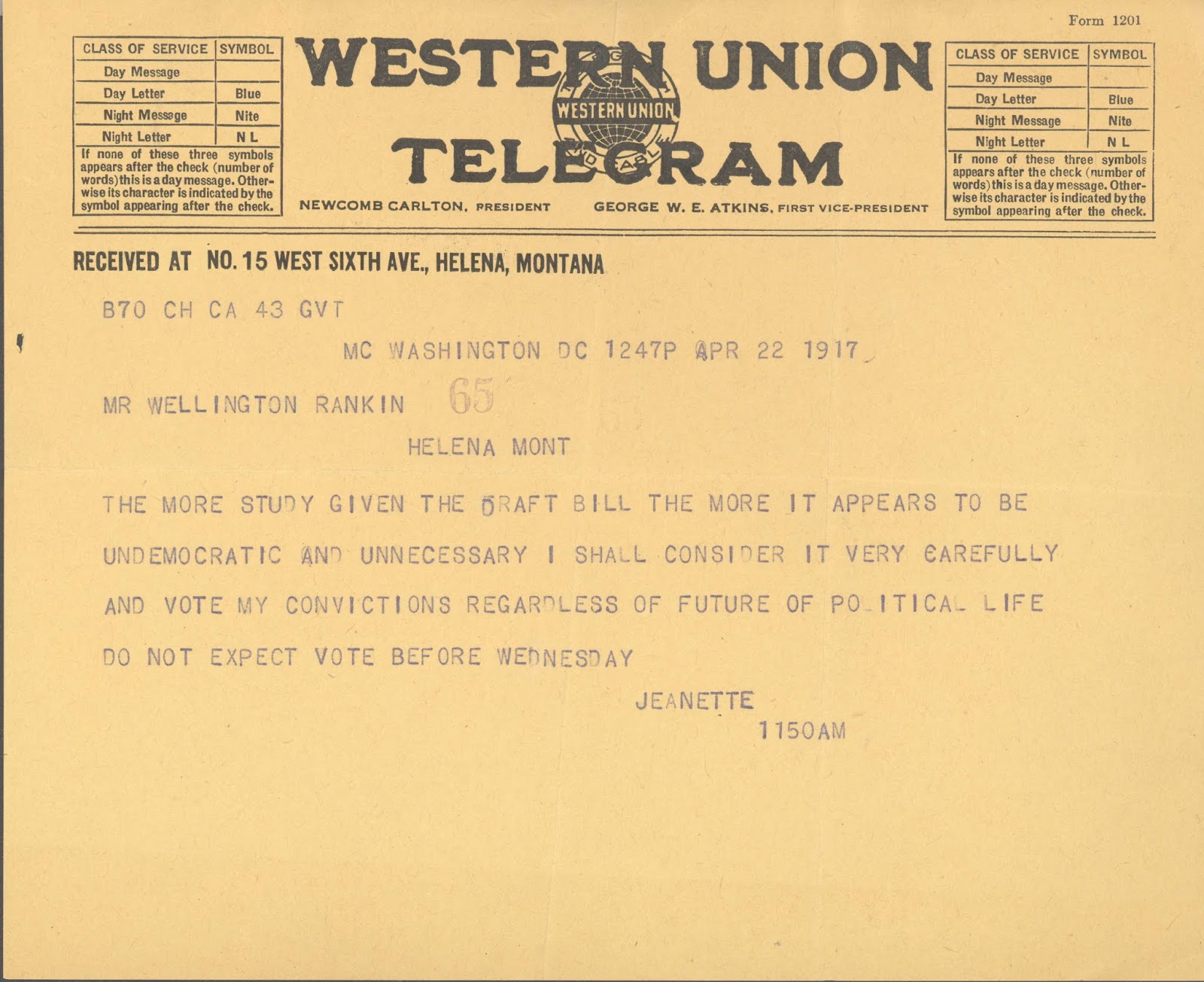
“I shall…vote my conviction regardless of future of political life.” Jeannette Rankin to Wellington Rankin, April 22, 1917. Jeannette Rankin papers, MC 147, box 1, folder 1, Montana Historical Society Research Center, Archives. (Hereafter JR papers)“let your conviction be right and not sickly.” Wellington Rankin to Jeannette Rankin, April 22, 1917. JR papers, box 1, folder 1.“Grieved at vote but opposition makes me stronger for you.” Wellington Rankin to Jeannette Rankin, April 28, 1917. In this case Wellington was partly misinformed, Jeannette had voted for a competing conscription bill instead of President Wilson’s. JR papers, box 1, folder 1.“Mining companies no possible way to blame.” Wellington Rankin to Jeannette Rankin, June 20, 1917. Wellington correctly predicted Jeannette’s response to the Granite Mountain/Speculator Mine Disaster of 1917 and tried in vain to limit the political damage of opposing the Anaconda Copper Mining Company. JR papers, box 1, folder 1.
As critical as Wellington could be in private correspondence, in public he always maintained a united front with his sister. Even after Jeannette’s vote against entry into the Second World War made her politically toxic in Montana, Wellington refused to publicly criticize her during his own 1942 Senate run. Repaying loyalty with loyalty, during each of Wellington’s doomed campaigns Jeannette reached out to progressive and labor voters alienated by her brother’s increasing conservatism.
“My brother has been an active friend of labor always.” Jeannette Rankin to Edward Keating (editor of the newspaper Labor), June 11, 1934. Wellington D. Rankin papers, box 26, folder 4, Montana Historical Society Research Center, Archives. (Hereafter WR papers)
Money defined more than the Rankins’ political relationship, as Jeannette’s sources of income were often sporadic and unreliable while Wellington amassed an enormous fortune from his law practice, ranching empire, and business interests. Throughout the 1930s and 1940s, Jeannette relied upon Wellington’s financial support to care for their ailing mother and to afford expensive trips to Europe, Asia, Africa, and South America. At the same time, she adopted an idiosyncratic and anti-materialistic personal lifestyle and her politics became increasingly anti-capitalistic. This uncomfortable dynamic sometimes strained the siblings’ relationship, but again never broke their fundamental family loyalty.
“You were very good to send me the checks. For anyone without a salary I’m getting on fine.” Jeannette Rankin to Wellington Rankin, January 24, 1940. WR papers box 2, folder 9.“I feel very badly over all the horrid things I said…I really do appreciate all you have done…to make it possible for me to go to Europe.” Jeannette Rankin to Wellington Rankin, July 25, 1937. WR papers box 2, folder 9.
Jeannette and Wellington’s relationship was far from that of typical siblings, yet its complex dynamics were driven by a relatable mix of love, loyalty, resentment, rivalry, and extreme familiarity common to all families. These archival records complement our understanding of the past and ultimately humanizes its very human subjects.
The exhibits are lonely—their main visitors now are staff continuing to work in the building and security staff making their rounds.
How do the exhibits and collections fill their time?
In the Russell gallery, cowboys meet around a campfire (no concern here for social distancing) where they tell jokes and stories, reminisce about their lives, or dream about future possibilities.
Another group is disrupted by a bronc, who has either had too much coffee, or not enough. Or perhaps he is simply enforcing the social distancing rule.
Charlie is ever ready to spin a yarn and add color to your imagination. He’ll model you a mini animal—something his talented fingers can do without supervision—and will pull from his pocket a surprise. Knowing Charlie's affinity for horses, you bet that's what it's going to be; but no … it's a pig. How clever. You guessed wrong—this beer is on you!