May 18, 2017

EXTRA! Montana Newspaper Stories 1864-1922: Statehood

By the 1880s, residents of the Montana Territory were ready to embrace statehood and enjoy benefits like full representation in Congress, the power to tax local corporations, and federal land grants to support education. Although there had been previous attempts locally and nationally to create the new state, it took 25 years for Montana Territory to become a state.


Key dates

February 22, 1889—President Cleveland signs the Omnibus Bill, an "enabling act" notifying North Dakota, South Dakota, Washington, and Montana that if they drew up proper constitutions, they would be granted statehood.
July 4, 1889—Representatives elected from across Montana open a constitutional convention in Helena.
October 1, 1889—In a general election, Montanans approve the new state constitution and elect Joseph K. Toole governor.
November 8, 1889—President Harrison proclaims Montana the 41st state.


From the newspapers


To find more

Search for these terms: constitutional convention, statehood

Written by Catherine W. Ockey


__________________________________________________________________________________
If you haven't completed our survey to learn about your experience with this blog, please click this link.  Thank you for your feedback.

May 11, 2017

A Continuing Journey: The Conservation of Published Accounts of the Journals of the Corps of Discovery

Molly Kruckenberg
Research Center Director


William Clark, Meriwether Lewis and the Corps of Discovery’s successful return to St. Louis on September 23, 1806, was far from the end of the story of the Corps.  Tasked with keeping a written record of their journey, Lewis and Clark as well as several other members of the expedition kept daily journals of their activities.  Sergeants John Ordway and Patrick Gass as well as Private Robert Frazer were among those that also kept a record of the journey. [i] After the return of the Corps there began a brief battle over who would publish the first account of the expedition.

Although rumors of a publication of Private Frazer’s journal surfaced and Lewis did his best to discredit publications not by he and Clark[ii], Patrick Gass’ journal was the first one published.  Shortly after returning from the Expedition, Gass had sold his journal and publication rights to David McKeehan, a Pittsburgh, PA, bookseller.  After much editing and transcription, McKeehan published the journal in 1807, under the title Journal of the Voyages and Travels of a Corp of Discovery and followed with an additional printing in 1808.  Two years later, Mathew Carey of Philadelphia, acquired the copyright to Gass’ journal and published more editions in 1810, 1811, and 1812.


It wasn’t until 1814, five years after Lewis’ death, and through the work of Philadelphian Nicholas Biddle, that Clark was able to see an edition of the official journals published.  Clark had worked closely with Private George Shannon to assist Biddle in the production of History of the Expedition under the Command of Captains Lewis and Clark.[iii]  Published by Bradford and Inskeep, also of Philadelphia, the two-volume set was primarily a narrative account of the expedition and did not include any details of the scientific discoveries recorded by Lewis and Clark.[iv]

The MHS Research Center is fortunate to hold several early publications of the journals of the Lewis and Clark Expedition, including an 1810 edition of the Gass journal and the 1814 Biddle edition of Lewis and Clark’s journals.  While the Gass journal is a recent donation, the Biddle edition has been in the care of the Research Center for more than a century. 

Kept in our secure and environmentally-controlled storage facilities, these volumes are a significant part of our rare book collection.  Given their age of more than two centuries, though, the books were beginning to show some gentle wear and tear.  Last year the Research Center undertook a project to see that these volumes were properly conserved so that they would be available for use and study for the next two hundred years.


The professional conservators at the Northeast Document Conservation Center in Andover, Massachusetts received the books in the fall of 2016 and conducted an initial review of their condition.  Each of the three volumes contained several issues, from patches and scuffs on the leather covers, to dirt, discoloration and water stains.  Conservators cleaned the pages, repaired bindings, reinforced sewing, mended tears and created custom storage boxes for each volume.  The images here illustrate the before and after condition of the title pages for two of the volumes.  The completion of this work stabilizes the volumes making them ready for study by the next generation of Montana history scholars.

The Research Center works continually to balance our joint missions of conservation and preservation of collections with public access to the materials that tell Montana’s history.  Through the conservation of the 1810 edition of Patrick Gass’ journal and the 1814 Biddle edition of Lewis and Clark’s journals, we are continuing our work to ensure Montana’s history is available for research far into the future.


[i] Private Joseph Whitehouse also kept a journal and Sergeant Charles Floyd kept a journal until his untimely death August 20, 1803.
[ii] Meriwether Lewis published a notice in the National Intelligencer (Washington D.C.) on March 18, 1807 warning the public not to purchase any publication about the Expedition not authored by himself.
[iii] The complete title is History of the Expedition under the Command of Captains Lewis and Clark, to the Sources of the Missouri, Thence across the Rocky Mountains and down the River Columbia to the Pacific Ocean.
[iv] Aarstad, Rich and Jennie Stapp. “Travel and Exploration Narratives in the Montana Historical Society Collection.”  Montana the Magazine of Western History (Vol. 55 No. 3), p63-65.


April 20, 2017

EXTRA! Montana Newspaper Stories 1864-1922: The Mullan Road

Before the extension of the Northern Pacific Railroad in 1883, it was difficult to get people and goods from one side of Montana Territory to the other. The Mullan Road was a U.S. Army project built to move troops to the Indian wars. Named for Lieutenant John Mullan, it was the first wagon road to extend from the Missouri River over the Rocky Mountains, through Northern Idaho and beyond. The road became a vital transportation link, and parts of it were incorporated into major roadways that are still in use.


Key dates

1859—The U.S. War Department appropriates funds for construction of a military road between Washington Territory and the Missouri River.
1862—The Mullan Military Road is completed.
1880—Improvements are made on sections of the old Mullan Road.
1893—The completion of the Great Northern Railroad through Montana decreases demand for an overland wagon route.


From the newspapers


To find more

Search for the following terms in combination, proximity, or as phrases: mullan, mullan road, western slope

Written by Catherine W. Ockey

April 6, 2017

Jeannette Rankin and Her War Vote

by Natasha Hollenbach, Digital Services Technician

On April 2, 1917, Jeannette Rankin, the woman from Montana, made a triumphant entrance into Washington, DC as the first woman elected to Congress. Four days later the mood had changed drastically as she sat in the House with her fellow representatives debating the issue of US entry into World War I.

Catalog # 944-480
Jeannette Rankin, April 2, 1917
First appearance in Washington
Photographer Unidentified

The depiction of her vote commonly told today is well represented in Montana: Stories of the Land [1] which describes the scene like this:
“When her turn came, Rankin stood up. “I want to stand by my country but I cannot vote for war,” she said. Only a few other members of Congress shared her view, and the resolution to enter World War I passed overwhelmingly.” 
This simple depiction is quickly overturned by even a cursory look at the newspapers of the day who gave shockingly variable descriptions of her vote. [2] Was she weeping, sobbing, or trembling? Did she sit back down, disappear out a side door, or carried out? Did her vote provoke cheers or disdain? Even her now-famous quote wasn’t consistently reported, with at least one paper declaring that she never actually voted at all [2c] and another having her say “No matter what stand my country may take in this, I cannot cast my vote for war.” [2f]

Being the first woman in Congress meant that her votes and opinions never reflected on her alone. Unlike her male colleagues who voted against war (49 in the house and 6 in the senate), the newspapers declared that her vote would impact the national suffrage movement. [3] Opponents of suffrage declared that she proved that women couldn’t be entrusted with issues of national importance. Proponents of suffrage reacted in one of two ways. They either disavowed her actions or since one of the main arguments against women in politics was that it would coarsen them, they pointed out that Jeannette’s vote proved that women in politics could still retain womanly attitudes.

However, the press reaction is only part of the story. The correspondence sent to Jeannette Rankin both before and after the vote by constituents and other Americans (usually women) from across the country offer a more complicated reaction to her vote. [4] While there are some letters in opposition, their number is hardly overwhelming. Most of the letters supported her vote and even some of those who oppose her vote applaud her courage in voting as she did. The first notable observation are the two form letters, one for those opposed and one for those in support, that she sent in response. The striking comment to those who wrote in opposition declared that “…the letters and telegrams that come to me from Montana were sixteen to one against the war resolution.” It quickly becomes apparent that by the writer’s count the overwhelming feeling in their section is identical to the writer’s. While the newspapers focus on suffrage the correspondence is more varied. First they often criticize the press reporting.

From top to bottom:
Excerpt from letter by Byron DeForest, Great Falls, Montana. August 9, 1917. MC 147, Box 10, Folder 9. 
Excerpt from letter by  Mrs. DeLoss, Ekalaka, Montana. April 23, 1917. MC 147, Box 10, Folder 5. 
Excerpt from letter by  Ella and W. A. Grandey, Whitehall, Montana. MC 147, Box 10, Folder 5. 
Excerpt from letter by  R. J. Whitaker, Missoula, Montana. March 29, 1917. MC 147, Box 10, Folder 7. 

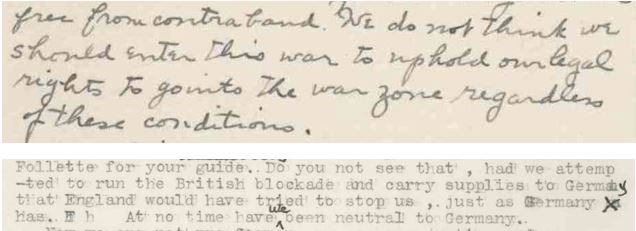
Second, the newspapers tend to take it for granted that the war is justified, while the letters show much less uniformity of opinion. Many openly question both whether the US ever acted as a neutral power and whether, even if the justifications for war were accurate, they are worth going to war over.

From top to bottom:
Excerpt from letter by Ella and W. A. Grandey. March 27, 1917. MC 147, Box 10, Folder 9. 
Excerpt from letter by Laura Booth Hall, Ekalaka, Montana. April 5, 1917. MC 147, Box 10, Folder 4. 

Particularly interesting are those who wrote multiple times. The best example is Ralph E. Courtnage [5] who wrote to Jeannette on April 12th strongly registering his criticism of her. She responded with her usual form letter, and a delightful thing happened (from a historian’s point of view). He wrote her again on June 15th. This time expressing regret over his earlier tone and concerns about liberty, security of law and the power of the president, clearly referencing the attitudes and actions which led to the sedition law. This continuing dialogue about the changing issues and attitudes reminds the reader that the war vote was only a moment in time connected to both the past and future of those living it.

References: 
[1] Montana: Stories of the Land. Chapter 16 – Montana and World War I, 1914-1918, pg. 315. http://svcalt.mt.gov/education/textbook/Chapter16/Chapter16.pdf 
[2] a sampling of articles showing the range of how the vote was described (all articles available on ChroniclingAmerica.)
     a. Columbus Commercial (Mississippi), April 8, 1917. 
     b. Topeka State Journal, April 6, 1917. 
     c. Ward County Independent (North Dakota), April 12, 1917.
     d. Harrisburg Telegraph (Pennsylvania), April 6, 1917. 
     e. “Woman Votes No.” Free Trader-Journal (Illinois), April 6, 1917. {2 clips} 
     f. “By a Vote of Three Hundred Seventy-Three to Fifty The House Casts Lot With The Powers of the Entente”.       
          Hawaiian Gazette, April 6, 1917. 
     g. “Dramatic Scene.” Daily Gate City and Constitution-Democrat (Iowa), April 6, 1917. 
[3] sampling of articles showing reactions of both suffrage opponents and proponents (all articles available on ChroniclingAmerica.)
     a. “A Hard Jolt for Suffrage”. St. Joseph Observer (Missouri), May 19, 1917. 
     b. [Kansas City Star] Harrisburg Telegraph (Pennsylvania), May 4, 1917. 
     c. “Miss Rankin’s Weakness.” Ogden Standard (Utah), April 11, 1917.
     d. [Billings Journal and Butte Miner] Daily Missoulian, April 11, 1917.
     e. [Comments by Charles A. Krause]. El Paso Herald, April 11, 1917.
     f. [Lewistown Argus.] Fallon County Times, May 10 1917. 
     g. [Red Lodge Civic League] Daily Missoulian, April 16, 1917.
     h. “Miss Rankin’s Vote Own View—Suffragist”. East Oregonian, April 13, 1917.
     i. “The Sobbing Woman.” Evening Times Republican (Iowa), April 30, 1917.
     j. [Record-Herald of Helena] Daily Missoulian, April 14, 1917.
     k. Jenkins, Alice. “Miss Rankin’s “Sensibility.”” Evening Star (DC), April 18, 1917. 
     l. “Miss Rankin’s Vote.” West Virginian, April 7, 1917.
     m. “The Case of Miss Rankin.” Daily Missoulian, May 11, 1917.[4] MC 147, Box 10, Folders 4-10 
[5] Ralph E. Courtnage, Great Falls, Montana. April 12, 1917 & June 15, 1917. MC 147, Box 10, Folder 4.

March 16, 2017

EXTRA! Montana Newspaper Stories 1864-1922: Yellowstone National Park

Although the unique geological formations of the Yellowstone area were known to Native Americans and early white explorers, it wasn’t until the 1871 Hayden expedition that the rest of the U.S. population believed the stories. Photographs from the expedition were published and just a year later, in 1872, Congress created Yellowstone National Park. It quickly became a popular tourist attraction and a model for national parks in other countries.


Key dates

1805-06—Members of the Lewis and Clark Expedition hear reports of a volcano south of the Missouri River.
1807-08—Former Expedition member John Colter travels alone through a large tract of present-day Wyoming as far south as Jackson Lake. After he reports astonishing sites such as geysers and rivers of boiling water, the area is jokingly referred to as “Colter’s Hell.”
1870—The Washburn–Langford–Doane Expedition returns with detailed maps and observations, and various members publish first-hand accounts in national periodicals.
1871—Congress appoints Ferdinand V. Hayden to make an official geological survey. Hayden is accompanied by artist Thomas Moran and photographer William Henry Jackson.
March 1, 1872—President Grant signs a bill creating the world’s first national park. It is comprised of 2.2 million acres of wilderness.
1894—The Lacey Act prohibits “the hunting, or the killing or wounding, or capturing. . . of any bird or wild animal, except dangerous animals” in the Park.


From the newspapers


To find more

Search for these terms in combination, proximity, or as phrases: yellowstone park, dr. ferdinand hayden, nathaniel pitt (n.p.) langford, henry d. washburn, john colter

Written by Catherine W. Ockey