April 25, 2018

Les Jorud and "The Seventh Annual Vigilante Day Parade"

By Kelly Burton, Film Archivist

Costumed students from The Seventh Annual Vigilante Day Parade (collection PAc 90-50)


When speaking of photography in Helena, Montana, few names are as recognizable as that of Leslie H. Jorud (September 19, 1899 – August 21, 1977). Over the course of five decades, Jorud’s career in photography took him “into a cage with five lions, 275 feet up inside the smokestack at the AS & R smelter in East Helena, into morgues and operating rooms, into the wilderness alone with a nervous horse who wanted to go home, into a bucket over Canyon Ferry dam, down into mines, up steep mine shafts, in airplanes and to all the major events in Helena.”[1] In addition to the 50,000 negatives and 7,000 prints currently being processed in the Montana Historical Society’s Photo Archives, the institution is also home to 47 motion picture films created by the Jorud Family. These 16mm home movies span the early-1930s through the mid-1950s, and they provide contemporary viewers with a wonderful document of Montana culture during the first half of the twentieth century.

Costumed students from The Seventh Annual Vigilante Day Parade (collection PAc 90-50)

One of the major Helena events to be captured by the Jorud Family movie camera is the Vigilante Day Parade. Boasting elaborate costumes and floats that find a common theme in the region’s past, the event is perhaps better described as a mobile history pageant. A public letter from former Helena High School principal (and then-current Helena mayor) Albert J. Roberts in 1939 provides the most thorough narrative concerning the parade’s inception. Roberts claims to have inherited several school traditions that were “subversive to discipline, often lawless in character, and in the main hostile to the good work and reputation of the school,”[2] the worst being the ‘Senior-Junior Fight’. The activity moved to Helena streets and alleys after being banned by the school administration, and “a few boys each year came out of the fray with black eyes, bloody noses, teeth knocked out, faces scratched and bodies bruised, all for the honor of the ‘biggest and best class ever graduated from the Helena high school.’”[3] Other attempts to celebrate the end of the school year – ‘Sneak Day,’ ‘Old Clothes Day,’ ‘Hard Times Day,’ and ‘Costume Day’ – eventually became the Vigilante Day Parade: “After much serious discussion of the situation, and other readjustments of the entire activity program of the upper-classes, it was decided to put on a big historical pageant, in which every boy and girl in High School would have an essential part. The pageant, later called the Vigilante Parade, was intended to present in the main the adventurous life and colorful customs of the Montana Pioneer, especially the Pioneer of Last Chance Gulch. To the promotion, work and achievement of this program, the Senior and Junior classes gave their wholehearted support, a pledge, which to the present time has been faithfully and diligently observed.”[4]

Costumed students and spectators from The Seventh Annual Vigilante Day Parade (collection PAc 90-50)

While the MHS moving image archives contains several reels of the Vigilante Parade in various collections, the Jorud Family footage from May 16, 1930 represents the oldest and best-preserved film of the pageant at the MHS repository. Though only in its seventh year at the time of the film’s creation, the event garners a sense of civic enthusiasm that is echoed in the advance newspaper coverage: “The parade this year will equal or surpass that of preceding years, the boys and girls declare. The streets will be cleared of cars, and the juvenile burlesquers will be given the fullest latitude for their performances. Already the youngsters of Helena are excitedly discussing the Vigilante Parade as the next local event of superlative importance. It will be a grand and glorious event from all standpoints of the rising generation.”[5] The anticipatory article goes on to describe several of the entries to be captured by the Jorud Family camera, including the “old swayback horse and two-wheeled cart illustrating the rig of early days, the six-horse stagecoach of Canyon Ferry, a hangman’s float with a replica of Hangman’s tree, and a long string of pack mules lent by the federal government.”[6] At almost twelve minutes, the reel documents preparations by students on the day the parade, the passing of dozens of the historical entries along the pageant route, and audience reactions to many of the displays.

Costumed students and spectators from The Seventh Annual Vigilante Day Parade (collection PAc 90-50)

Home movies such the one created by the Jorud Family provide great insight into the evolution of our civic traditions – they allow us to see what has changed and what remains the same. Mayor Albert Roberts happily noted in 1939 that “thousands of our citizens have obtained a knowledge of the life and customs, of the thrilling story of the early days in the Treasure State”[7] through the Vigilante Day Parade. The 94th Annual celebration of the pageant takes place in Helena on May 4, 2018, and one supposes that Roberts would be still more excited to learn that his fledgling event is now nearing its centennial.

The hangman's tree and spectators from The Seventh Annual Vigilante Parade (collection PAc 90-50)

[1] Helena Independent Record, June 26, 1955.
[2] Helena Independent Record, May 28, 1939.
[3] Ibid.
[4] Ibid.
[5] Helena Independent Record, May 7, 1930.
[6] Ibid.
[7] Helena Independent Record, May 28, 1939.

April 12, 2018

Ephemera 101: When are you going to clean under your bed?

By Zoe Ann Stoltz, Reference Historian

ephemera 1 : something of no lasting significance 2 : paper items (such as posters, broadsides, and tickets) that were originally meant to be discarded after use but have since become collectibles

When mom ordered me to “clean under my bed,” she was not referring to the dust bunnies.  She was despairing over my teenage clutter: movie calendars, church bulletins, pamphlets, tickets, and so much more.  Fortunately, a lot of folks were not raised to worry about such clutter.  Rather, they collected and savored programs, advertisements, bulletins, and more. Some of these memorabilia find their way to the MHS Research Center’s Ephemera Collection.

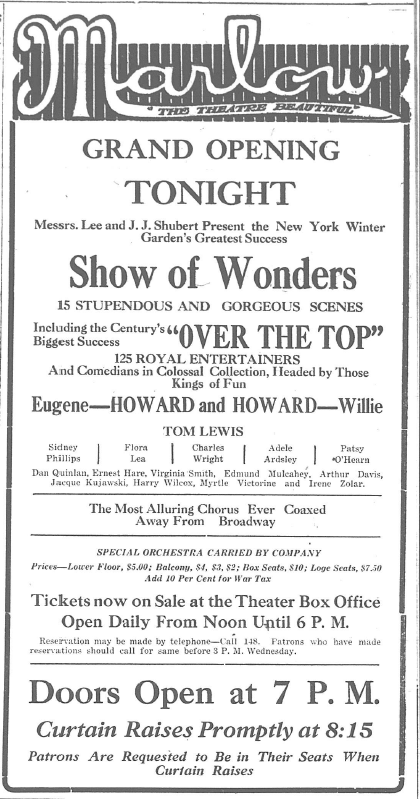
Recently two pieces of ephemera from 1918 landed at the MHS Library.  These century old documents offer informative glimpses of Helena as well as Montana’s cultural environment.  The first is a theater program dated April 4, 1918 from Helena’s Marlow Theater. In hopes of understanding the context of the piece, I searched the 1918 Helena Independent. I discovered that just the day before, April 3, was the Marlow’s grand opening and Helena’s social event of the year!  Newspaper headlines described the “Capital Elite in Force.”  The sheer spectacle of scenery and costumes of “Show of Wonders” amazed the crowd.  However, the Independent critiqued the chorus as “young and pretty and shapely,” but “not a real voice in the lot.”  Also reported was a generous gift of $50.00 for “Red Cross Women to Attend Marlow Opening,” sent by the vacationing Senator T. C. Power. [1]

Advertisement
The Helena IndependentApril 3, 1918
Marlow Program
April 4, 1918
MHS Research Center Ephemera Collection


The program itself delivers a plethora of historic information.  It lists the schedule for the Marlow in the coming weeks, from vaudeville and musical performances to “black face comedians” and drama.  Fisher’s Millinery, the State Nursery & Seed Company, and Montana Phonograph Company are just a few of the dozens of businesses advertised.  The leaflet also lists the Theater’s stockholders and firms connected to the Theater’s construction.  In short, the program offers an exciting glimpse into Helena’s businesses, society, and the era’s entertainment culture. [2]

Montana State War Conference, May 28-29, 1918
MHS Research Center Ephemera Collection

The second booklet is for the May 28-29, 1918 Montana State War Conference, coincidentally, held at the recently christened Marlow Theater. Numerous delegate organizations are listed.  Governing bodies such as the Red Cross, Liberty Loans, Federal Food Administration, Extension Bureau, and County Councils of Defense are predictable.  The presence of groups such as YMCA, Rotary Clubs, and Knights of Columbus reflects the depth of mainstream participation. The Conference’s patriotic goals were highlight by musical performances of Marseillaise, America, and Battle Hymn of the Republic.  Newspaper reports emphasize the diversity of backgrounds represented by speakers. They included Lt. Paul Perigord, a Catholic priest turned soldier, and Dr. James A. B. Scherer, Lutheran Minister and expert on Japanese relations.  The Independent declared that “in Montana, politics, religion, sex and creed have been forgotten.” The common goal was to “help the national government win the war.” [3]   The many organizations represented at the Conference played integral roles in not only uniting Montanans, but in monitoring and regulating individual behavior. 

While the Marlow program creates images pertaining to 1918 recreation and entertainment, the Montana State War Conference pamphlet reminds readers of the countless organizations and coordinated efforts necessary to win the war.  Two very different perspectives of 1918 Montana, both accessed through items not meant to last a house cleaning – ephemera. 


[1] “Helena Theater Opened, Capital Elite in Force,” pg. 1 & 7,  “Senator T.C. Power Gives $50,” pg. 8, Helena Independent, April  3,1918.
[2] See Montana Historical Society Research Center Ephemera Collection, “Helena (Montana)-Theatres-Marlow Theatre.”
[3] “History is Debated by Councilmen,” Helena Independent, May 28, 1918, pg. 1 & 6.


April 2, 2018

National Boot Day...Montana-Style, April 13, 2018


Barbara Pepper-Rotness, MHS Research Center Reference Librarian

April 13th is #NationalBootDay and we are celebrating it Montana-style…with cowboy boots, of course! Visit us April 13, 2018 wearing your western-style boots to receive free admission.

Also, we are creating a new Pinterest board dedicated to this day and we need your help! Read below to learn how you can play our Facebook sweepstakes and participate in this collaborative collection.

The picture of the cowboy boots below is our most popular image on Pinterest and is the inspiration for our #NationalBootDay event.
Image: MHS Museum #2004.47.01
Play to win:
  • Two books published by the Montana Historical Society Press
    • A Tender Foot in Montana, by Francis M. Thompson, ed. by Kenneth N. Owens
    • Charlies Russell Roundup, ed. by Brian Dippie
  • One issue of Montana The Magazine of Western History
  • Several postcards from our store
  • MHS bookmarks and pencils from the Research Center

Play to win:
Gifts you could win (minus the boots)
Image by Tom Ferris, MHS Photographer

Enter Sweepstakes:
  • Go to our Facebook Page to enter.
  • Add one clear, close-up image of your cowboy or western-style boots (boots only, no people) in the Comments field of our April 13 #NationalBootDay Facebook post. Submissions for the contest will be accepted through 5:00pm on April 16th.
  • “Pick a Winner”, a third-party app sponsored by Woobox, will randomly select a winner at 5:01pm (MDT) April 16th.
  • Photos will be displayed on our Pinterest #NationalBootDay…Montana-Style board*.
 *During the month of April, you can watch our Pinterest ‘channel’ set to the #NationalBootDay board. Click on the Pinterest tab (no mobile access) on the left side of our Facebook Page and watch this gallery grow!

Well-worn cowboy boots
Image by Tom Ferris, MHS Photographer
Eligibility:
  • Must be eighteen years or older to win.
  • Must be a resident of the United States to win.
  • We reserve the right to remove any images that contain faces, names, profanity, nudity, hateful or political content. Removal of your image will nullify your eligibility.
  • Employees of MHS are restricted from entering contest. 
Conditions:
  • No purchase necessary to win.
  • Playing this game is not required to receive free admission to the museum on April 13th; nor, is admission to the museum contingent upon entering the contest.
  • Must access our Facebook Page to play.
  • Submit one clear (not blurred) image, 600 x 900 pixels minimum for Pinterest.
  • We will not use names for any purpose other than to notify and announce the winner.
  • Winner will be notified by April 17, and winner will be announced (after verifying his/her compliance with our official rules) on Facebook no later than April 30, 2018.


Disclaimers:
  • By entering this contest, you agree to a complete release of Facebook and Pinterest from any liability in connection with this contest.
  • This promotion is in no way sponsored, endorsed, associated with, or administered by Facebook, Pinterest, or, other social networks.
  • By adding your image in the Comments field of our #NationalBootDay Facebook post, you are granting MHS permission to use image on other social media.
  • Prize has no cash value.


March 22, 2018

A Visit from Silent Cal

by Kelly Burton, Film Archivist

President Calvin Coolidge and Superintendent Horace Albright at the Grand Canyon of the Yellowstone, 1927 (PAc 93-25)

When speaking about photography in the American West, few names are as ubiquitous as Haynes. Frank Jay Haynes made his name by documenting the settlement of the west, ultimately becoming the first official photographer of Yellowstone National Park. Upon his retirement in 1916, his son, Jack Ellis Haynes, inherited his father’s business and continued as the official park photographer until his death in 1962. Jack began shooting motion picture film of Yellowstone shortly after the advent of 16mm film in 1923, and aside from a handful of commercial films for the park and the Northern Pacific Railway, these films can be classified as home movies. The Jack Ellis Haynes collection at the Montana Historical Society (PAc 93-25) documents Yellowstone’s ecology and its employees from the 1920s to the 1950s, as well as Jack’s family life during this time. Footage of his 1930 marriage to Isabel Nauerth is part of the collection, and the couple’s daughter, Lida, grows up in front of her father’s camera lens.

Dr. Hubert Work (center) with Albright (right) in Yellowstone National Park, 1927 (PAc 93-25)

In addition to capturing the daily lives of those who lived and worked within the park, the collection also documents the leisure time of several well-known Yellowstone visitors. One reel in particular highlights the amount of promotion that Superintendent Horace Albright undertook on behalf of the park in the very busy year of 1927. Labeled the “Celebrities Reel” by the Haynes Studio, this film features several notable names from the worlds of politics and finance: Dr. Hubert Work, Secretary of the Interior; Judge John H. Edwards, Assistant Secretary of the Interior; Dr. John Merriam, president of the Carnegie Institution in Washington D.C.; Dr. Harold Bryant, founder of the Yosemite Field School of Natural History; Will H. Hays, former U.S. Postmaster General and first chairman of the Motion Picture Producers and Distributors of America (MPPDA); and Kenneth Chorley from the Laura Spelman Rockefeller Memorial Foundation. It is worth noting that Yellowstone’s southern neighbor, Grand Teton National Park, was established in 1929, due in large part to Albright’s promotional efforts in the region.

Grace and Calvin Coolidge at Camp Roosevelt in Yellowstone, 1927 (PAc 93-25)

The most famous visitor on the “Celebrities Reel” is arguably President Calvin Coolidge, who came to Yellowstone with his wife, Grace, and his son, John, in the summer of 1927. After spending several weeks at their vacation lodge in South Dakota’s Black Hills, Interior Secretary Hubert Work urged the family to spend time in nearby Yellowstone before returning to Washington. (1) According to Albright’s memoir, the surprise visit came shortly after Coolidge issued the statement that he would not seek a second full term as president:
“Having made his decision not to run, he had thought he might as well add a few days to his vacation and get in some fishing in the park before returning to the summer heat of Washington. Bill Starling of the Secret Service came to Yellowstone with an advance party to check on security procedures, and wanted special protection measures taken. Starling told me not to announce ahead of time where the President would be going, and to be flexible with the planning because they might change the schedule with no notice. While I wanted to make it possible for the President to get his rest and relaxation fishing, I did not intend to miss the opportunity to push for some of our priorities.” (2)
Superintendent Albright ultimately satisfied Coolidge’s predilection for fishing, (3) and was even witness to the quiet president’s “peculiar style of wry, taciturn wit,”(4) but was somewhat less successful in discussing matters of park promotion with the president at that time. (5)

Albright and Coolidge at Artist Point in Yellowstone, 1927 (PAc 93-25)

The Haynes footage of the visit begins with the presidential motorcade approaching the north entrance to the park in Gardiner, Montana. Mounted park rangers salute from the side of the road as the automobile procession passes through Roosevelt Arch, so named for the president that laid its cornerstone in 1903. The touring group then poses in front of a wooden building at Camp Roosevelt, east of Mammoth Hot Springs on the Wyoming side of Yellowstone. Artist Point overlook on the south rim of the Grand Canyon of the Yellowstone provides Haynes with the most significant images from the celebrity visit, and it is from these viewing platforms that we see Superintendent Albright pointing out various features of the landscape to President Coolidge and his family.

Calvin, John, and Grace Coolidge at Artist Point, 1927 (PAc 93-25)

The Jack Ellis Haynes collection consists of 141 reels of 16mm film. Twenty of these films are available for viewing in the Montana Historical Society Research Center, and two of the commercial productions, Magic Yellowstone and Yellowstone Park: Scenic Wonderland of America, can be watched on the MHS Moving Image Archive YouTube playlist.

(1) Richard Bartlett. Yellowstone: A Wilderness Besieged (Tucson: University of Arizona Press, 1985), 97.
(2) Horace M. Albright. The Birth of the National Park Service: the founding years (Salt Lake City: Howe Bros., 1985), 211-212.
(3) Bartlett, 97-98.
(4) Albright, 212.
(5) Bartlett, 98.

March 15, 2018

Oh, The Places You'll Go: A Research Request Journey

by Barbara Pepper-Rotness, Reference Librarian

The Montana Historical Society’s Research Center receives an average of twenty paid requests per month for information on various subjects. No matter the topic, each request provides us with a question we must answer and forces us to look more in-depth at materials we may not have previously. Once the search begins, we embark on a journey that hopefully leads to an answer; or, at minimum, provides the patron with one or two pieces of the puzzle he/she is trying to solve. Whatever the question, we are always fascinated by what we learn.

A request for information about a building in Helena arrived recently. The patron was interested in knowing when this structure was first built and who resided there, both of which are typically easy to ascertain.

After verifying that the building is not listed on the National Register of Historic Places, we can use the Helena Polk City Directories to determine who currently resides at the address. We can also see who lived there when it was first built by searching under the street address (only in the Polk’s from 1929 to the present).

1954 Polk City Directory

When was it built, though? We used the current resident’s name found in the Polk City Directory to search for the property in the online Montana Cadastral database. Nothing came up, though.  Since this database is for valuation of property owned, the most likely explanation is that the person who resides or does business there is not the owner. If you don’t have a name to search, you can zoom in on the associated map. Once you select the correct plat, the corresponding data will display. The cadastral data indicates that this cabin was built in 1953 and we can verify that against the Polk Directory to see if the address is listed before 1953. It wasn’t. In addition, we can check our Helena Sanborn maps for surveys of that area. In the collection of 1930-revised-to-1953 maps, there was nothing surveyed above the 1500 block of 11th Avenue.

Because our patron also wanted information about the people who resided at that location, we must go back to the Polk City Directories and determine who lived there when. We tracked that ownership from the first resident to the present, noting each year the ownership changed.

From the Spokesman Review, November 11, 1951, p.2
The gem of this search, however, was learning about the first owner, Jean Barnes Allen, who resided and did business at 1807 11th Avenue. We were pleasantly surprised to find a vertical file for her and it held surprises of its own. Jean sold, from her home business, antler and horn carvings that she fashioned into buttons, belts, and jewelry.


From the Great Falls Tribune, November  18, 1962, p.2

The highlight of Jean’s life, though, was when she rode an eleven-year-old Morgan horse called Black Beauty 1500 miles from Deer Lodge, Montana to Chicago, by herself, for the Century of Progress Exposition of 1933, a trip that took sixty-eight days. Although on her own for the ride itself, and with only $10.00 in her pocket, she was greeted by fans and was welcomed into homes along the way. Of her experience in Chicago, she commented, “I had been told to watch out for gangsters in Chicago, but the only person I saw who looked like a gangster turned out to be an evangelist.”

From the Great Falls Tribune, November 18, 1962, p.2

We never know what we will learn, and will want to continue learning about, in our quest to help our patrons!

Sources:
Mac, ‘Tana. “Helena Woman recalls 1,500-Mile Ride on Horse.” Great Falls Tribune, November 18, 1962.
Friesen, Phyllis L. “When Extra Money Needed…Hobby Became Career.” Great Falls Tribune, March 29, 1970.
Helton, Dorothy. “Montana Headline Girl Runs Side-of-the-road Shop” Spokesman Review, November 11, 1951.